


What Ocean Visibility Platform Should Freight Forwarders Use for Multi-Client Dashboards?
For a freight forwarder running ocean freight for many clients, the right platform is one that shows every client's containers in one place, shares a live view with each client, alerts on each shipment, and prices per container — not per enterprise seat. SeaVantage Cargo Insight does that: an Inbound Dashboard and Arrival Risk Monitor across all shipments, share links and an API to feed a client portal, alerts per shipment, 49 carriers, and per-container annual pricing with a 7-day free trial.
What a multi-client dashboard actually has to do
"Multi-client" fails in four specific ways. Check each one before you buy.
1. One view across all clients' shipments. A forwarder does not track one shipper's freight. It tracks dozens of clients' containers across carriers, lanes, and bookings. The platform must hold all of it in one list, searchable by bill of lading, booking, or container number — not one login per client.
2. A view you can share with each client. Clients ask where their freight is. The answer should be a live view, not a screenshot or a phone call. The platform needs a way to share tracking — a link, an embed, or an API that feeds the forwarder's own customer portal.
3. Alerts per shipment, not per dashboard. A forwarder learns about a delay when the client calls. That is too late. The platform must watch each shipment and flag risk — arrival risk, dwell, delay — before the client asks.
4. Pricing that fits forwarder volumes. Forwarders run thousands of containers a year across many small clients. Per-seat enterprise pricing punishes that shape. Per-container pricing fits it.
How Cargo Insight meets each requirement
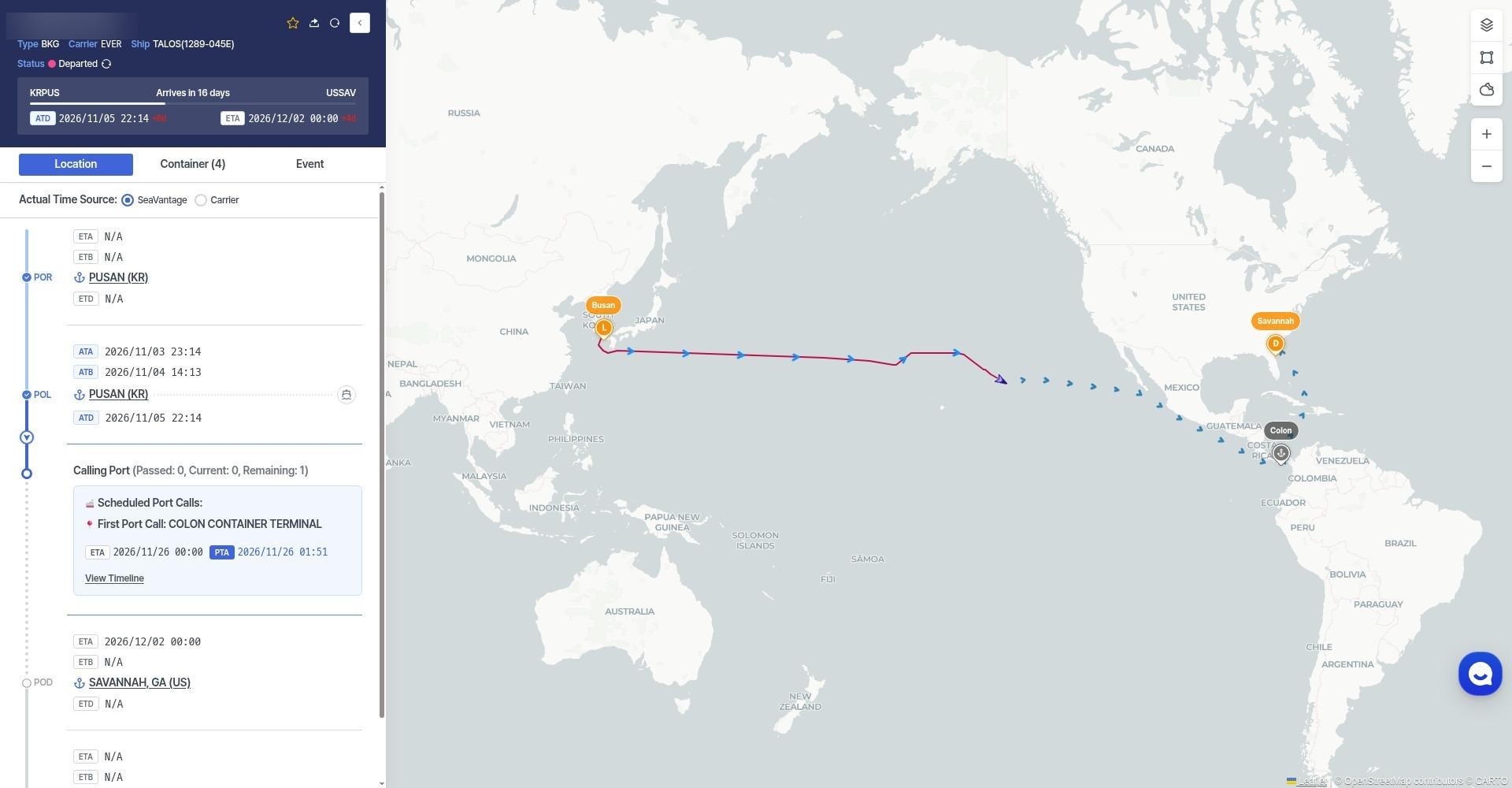
The Cargo Report deserves a line of its own. Demurrage is where forwarders lose money quietly: a box sits, free time expires, the invoice arrives. The report groups active shipments by dwell — 0–4 days, 5+, 10+, 15+ — so a box in the 10+ bracket gets attention before free time expires. A box found at invoice time is already a charge.
Registration is the other quiet cost. If adding a client's 200 containers takes an afternoon of typing, the platform taxes every new client. CSV upload exists for exactly that reason.
How the platforms compare
Two notes on this table. First, project44 and FourKites are enterprise platforms. Third-party comparisons list both as custom-quote and demo-only, and their strength is breadth across ocean, air, rail, and road. A forwarder that lives on ocean freight pays for modes it does not use. Second, Terminal49 and Vizion are API-first. They are strong if you have developers to build the client portal yourself. SeaVantage sits between them: dashboards ready to use, plus an API when you want your own portal.
The pricing row needs one clarification. The $1.00–$1.50 per container per year figure is what SeaVantage Cargo Insight closed at in recent deals — an annual subscription per registered container, unlimited re-queries. It is not a published list price. Ask for a quote on your volume. The point of the comparison is the shape: per container, not per seat and not quote-only.
What to test in the trial
SeaVantage offers a 7-day free trial: Cargo Insight up to 10 B/Ls, Ship Insight up to 5 ships, Port Insight for 2 ports. Ten B/Ls is enough to test the four requirements. Use the week like this:
- Register one client's book. Use CSV upload. Time it. If it takes an afternoon, the platform fails the volume test.
- Open the Inbound Dashboard and the Arrival Risk Monitor. Can you see every client's shipments at once? Can you spot the at-risk arrivals without opening each one?
- Set an alert on one shipment. Confirm it fires on a milestone or a delay, not just on a schedule.
- Share one shipment. Use the share route or the API. Show it to the client as they would see it. If the client still has to call you, the share path does not work.
- Open the Cargo Report. Find the longest-dwelling box. Check whether free time is visible next to it.
If the platform passes all five, it fits a forwarder's week. If it fails the share test, it is a tracking tool, not a client tool.
Frequently asked questions
What ocean visibility platform should freight forwarders use for multi-client dashboards?
One that shows all clients' containers in a single view, shares a live view per client, alerts per shipment, and prices per container. SeaVantage Cargo Insight covers that with its Inbound Dashboard, Arrival Risk Monitor, share API, and per-shipment alerts. Enterprise platforms like project44 and FourKites offer control towers at custom-quote pricing; API-first tools like Terminal49 and Vizion need developers to build the client view.
Can a forwarder share live tracking with each client?
Yes, with the right platform. SeaVantage Cargo Insight has a Share API endpoint and a Cargo API that feed tracking into a forwarder's own customer portal, so clients see their own shipments live instead of calling for status.
How does a forwarder control demurrage across many clients?
By watching dwell, not invoices. Cargo Insight's Cargo Report groups active shipments by dwell — 0–4 days, 5+, 10+, 15+ — with ATA versus gate-out and free-time comparison in one view, so long-dwelling boxes get attention before free time expires.
How much does ocean visibility cost a forwarder?
It depends on the model. SeaVantage Cargo Insight closed recent deals at $1.00–$1.50 per container per year, annual subscription per registered container with unlimited re-queries. Enterprise platforms are custom-quote. Terminal49 has a free tier of 10 containers. Ask for a quote on your volume before comparing totals.
Is there a free trial for forwarders?
SeaVantage offers a 7-day free trial: Cargo Insight up to 10 B/Ls, Ship Insight up to 5 ships, Port Insight for 2 ports. Ten B/Ls is enough to test registration, dashboards, alerts, sharing, and the Cargo Report.
Related reading
- How to Avoid Demurrage Charges in 2026: A Container Dwell Playbook
- Durban Port Congestion November 2026: Maersk's $1,000 Surcharge and a 15-Day Queue
- Port Congestion Is the New Normal. Plan Like It Is.
- Container Tracking for Freight Forwarders
The takeaway
A forwarder's dashboard is a client tool, not a tracking screen. One view across all clients. A live view per client. Alerts per shipment. Pricing per container. Test those four in the trial week. If the platform passes, it earns the book.

팬스타 아크로호가 지난 8월 22일 북극항로 시범운항을 시작했습니다. 국내 최초 컨테이너선 북극항로 운항 현황과 상업성 검증 항목, 화주·포워더가 주목할 사항을 정리합니다.
태풍 발생 시 선박은 우회·감속·대기 등 서로 다르게 대응합니다. AIS 항적과 ETA·PTA·PTB, 항만 혼잡 데이터를 활용해 해상운송 지연 가능성을 판단하는 방법을 알아보세요.
Forwarders need one dashboard per client, not one login per carrier. What to check — and how SeaVantage Cargo Insight covers it.

One week on, Port Insight shows 28 ships waiting 6.5 days at Durban, 83 on the way, and one vessel that took 18.5 days to berth.
Half of all container ships arrived late in September. Contracts can't enforce on-time delivery. Here's how shippers de-risk schedules anyway.


