


The Red Sea Threat Just Moved to the Port Gates
The war at sea has a new front. On 25 November the Houthis threatened to attack Saudi Arabia's Red Sea ports, naming Jeddah, Jazan, Yanbu, and the King Fahd Industrial Port in Yanbu. They published maps of the targets and told port staff to evacuate and shipping companies to withdraw their vessels at once.
The threat follows airstrikes on the Yemeni port of Hodeidah the same day. The Saudi-led coalition carried out at least six strikes on Hodeidah on 25 November, after an evacuation warning to civilians, according to maritime security company Vanguard Tech. The coalition confirmed it had targeted operational capabilities in the port. The damage to infrastructure, the impact on vessels alongside, and the port's operational status remain unclear.
No attack on a Saudi Red Sea port had been reported at the time of Vanguard's update. That is the one piece of good news. It may not last.
The threat is specific
Houthi military spokesperson Yahya Saree named the ports and published maps identifying them: Jeddah, Jazan, Yanbu, and King Fahd Industrial Port in Yanbu. The group called on port personnel to evacuate and on shipping companies to withdraw their vessels immediately.
This is a change. Until now the Houthis have threatened Saudi-linked ships. Now they threaten the ports themselves. Jeddah is Saudi Arabia's largest container port and a key call on Asia–Europe services returning to the Suez route. Yanbu handles oil exports and sits on the same Red Sea coast. A threat to the ports is a threat to the cargo inside them, not just the ships passing by.
The timing is deliberate. Carriers are bringing Asia–Europe services back through Suez after two years of Cape of Good Hope diversions. Those services call at Red Sea ports. Jeddah and King Abdullah Port are the natural stops. A credible threat to those ports lands directly on the Suez return.
The same day, in Hormuz
The Red Sea threat arrived alongside fresh reports from the Strait of Hormuz. Three Liberia-flagged crude oil tankers — Bahrain Prosperity, Cameroon Prosperity, and Romania Prosperity — were struck by unidentified projectiles on 22 November while transiting the strait. The UK Maritime Trade Operations centre issued three warnings on 24 November after reclassifying what it first reported as a single incident. All three tankers continued their voyages. All crew were accounted for. The extent of damage and any environmental impact remain unknown.
In a separate incident on 22 November, the Panama-flagged bulk carrier CTI Helen was struck by an unidentified projectile while at anchor off the UAE coast near Khor Fakkan. The strike caused a fire on board. No casualties were reported.
The two regions are now under pressure at once: Hormuz, where ten tankers were struck in a week, and the Red Sea, where the ports themselves are named targets.
Jeddah, right now
SeaVantage's Port Insight read Jeddah on the morning of 25 November:
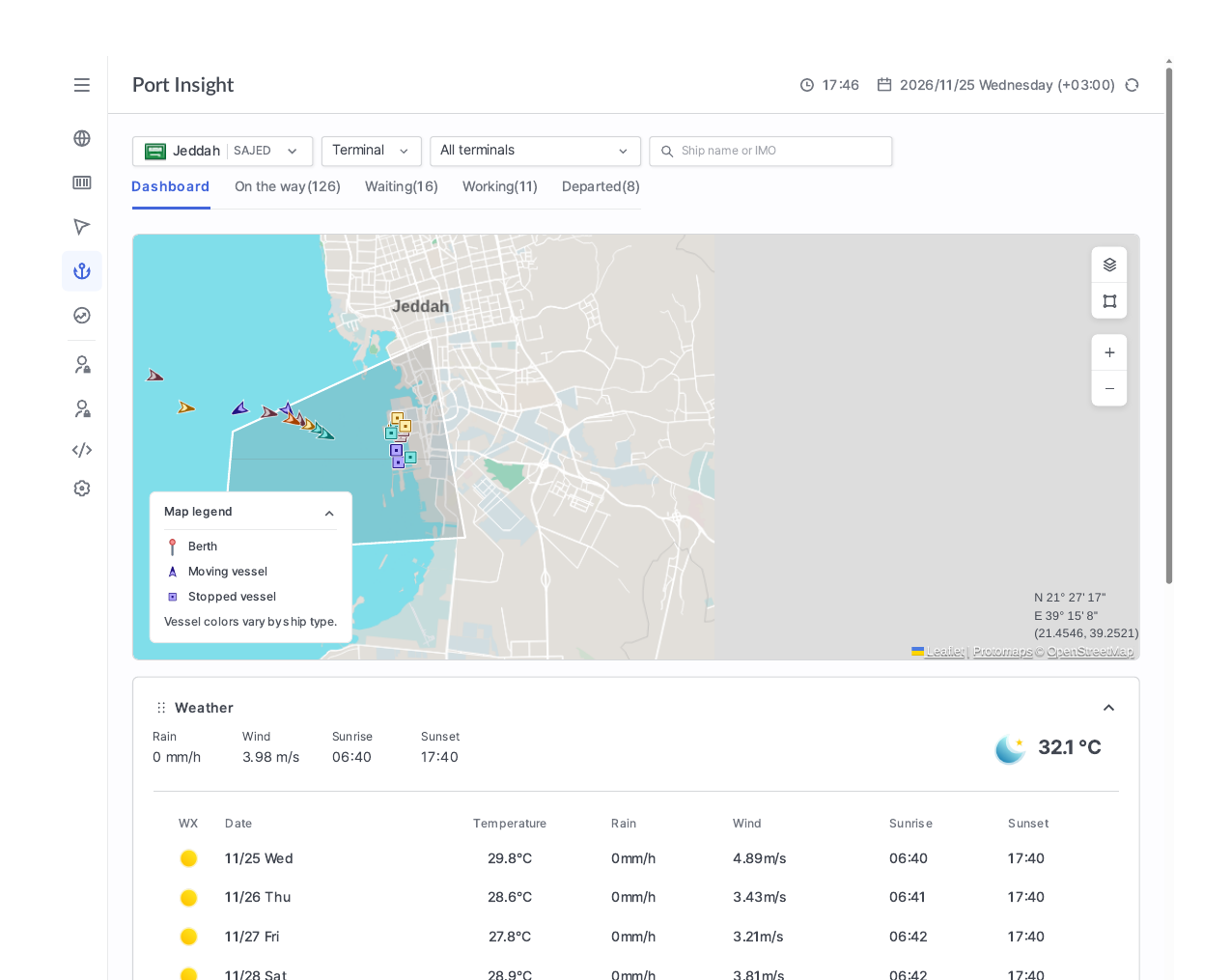
Sixteen ships wait an average of 12.2 days — the same count as yesterday, and still the 91st percentile of all ports. The threat has not moved the queue yet. It has given every shipper with Red Sea cargo a reason to watch it. One hundred and twenty-six vessels are on the way.
The Bab el-Mandeb Strait, the gate to the Red Sea, is also live in SeaVantage's Chokepoint Monitor:
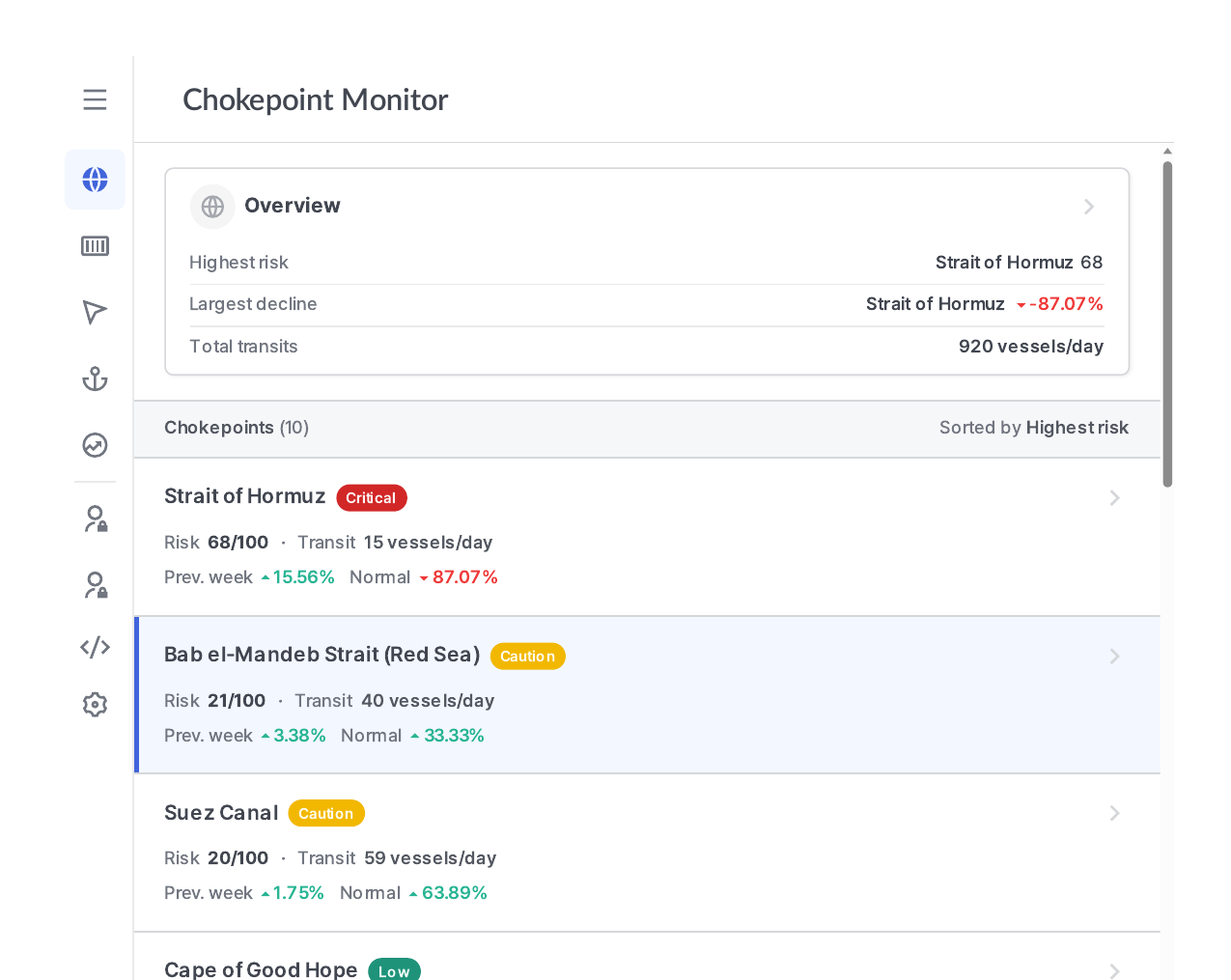
Traffic through the strait is still running a third above normal. The Suez return is flowing. The risk score is low, but the geopolitics component carries 15 of the 30 points in it. The threat to Jeddah sits at the far end of this strait. If lines start holding vessels back, the transit count will fall first.
What it means for shippers
A threat is not an attack. But a named port threat changes what a shipper must watch. Three things help.
Watch the port, not the headline. If lines start skipping Jeddah or holding vessels outside the Red Sea, the waiting count and the working count will move before the schedules do. Port Insight shows congestion, waiting times, and port-call records for Jeddah and every other major port. Check it before you route cargo through a named port.
Track the ship by IMO. Ship Insight tracks vessels by name, IMO, or MMSI, with live AIS position, ETA, and port calls. When a carrier withdraws a vessel or reroutes it around the Cape, the vessel's actual track tells you first — and PTA gives an earlier delay-risk signal alongside the carrier ETA. It is complementary, never a replacement, and never more accurate than the carrier's own ETA.
Track the container, not the service. If a Red Sea call is dropped, the box may discharge somewhere else and move on by feeder. Cargo Insight tracks containers by bill of lading, booking, or container number, with milestone updates and delay-risk signals. The tracking follows the box, whichever port it ends up in.
The Suez return was always a bet on security holding. Today's threat tests that bet at the port gates. Watch Jeddah's queue, watch the strait, and follow the box.
FAQ
Which ports did the Houthis threaten?
Jeddah, Jazan, Yanbu, and the King Fahd Industrial Port in Yanbu, all on Saudi Arabia's Red Sea coast. Houthi military spokesperson Yahya Saree named them on 25 November and published maps identifying them, calling on port staff to evacuate and shipping companies to withdraw their vessels.
What triggered the threat?
Airstrikes on the Yemeni port of Hodeidah on 25 November. The Saudi-led coalition carried out at least six strikes after an evacuation warning to civilians, according to maritime security company Vanguard Tech. The coalition said it targeted operational capabilities in the port. The damage and the port's operational status remain unclear.
Has any Saudi port been attacked?
No. No attacks on Saudi Red Sea ports in connection with the threats had been reported at the time of Vanguard's update on 25 November.
What happened in Hormuz on 22 November?
Three Liberia-flagged crude oil tankers — Bahrain Prosperity, Cameroon Prosperity, and Romania Prosperity — were struck by unidentified projectiles while transiting the Strait of Hormuz. All three continued their voyages and all crew were accounted for. The Panama-flagged bulk carrier CTI Helen was struck at anchor near Khor Fakkan, causing a fire. No casualties were reported.
Why does this matter for Asia–Europe shipping?
Carriers are returning Asia–Europe services to the Suez route after two years of Cape of Good Hope diversions. Those services call at Red Sea ports, including Jeddah and King Abdullah Port. A threat to the ports puts the Suez return itself at risk, not just individual transits.
What should shippers with Red Sea cargo do now?
Watch the live port data for Jeddah and the Bab el-Mandeb chokepoint before routing cargo through the Red Sea, track vessels by IMO so a reroute shows up early, and track containers by bill of lading, booking, or container number so a dropped port call does not break the trail.
Related reading
- Ocean freight outlook: Suez, Hormuz, chokepoint risk
- Port congestion: the new normal, November 2026
- Predictive ETA: Suez return, European imports
- How geopolitics will reshape global shipping in 2026
- AIS data that enables vessel position tracking
- ETA vs PTA in container shipping
- How to read SeaVantage's PTA and carrier ETA: real-world scenarios
- Durban port congestion, one week later
- Jeddah port congestion tracking
- Global Chokepoint Monitor — Bab el-Mandeb Strait
- Global Chokepoint Monitor — Strait of Hormuz
The takeaway
The Houthis have moved from threatening Saudi-linked ships to threatening Saudi ports by name: Jeddah, Jazan, Yanbu, and King Fahd Industrial Port. No attack has been reported yet. But the threat lands directly on the Suez return, and on every Asia–Europe service that calls at a Red Sea port. Watch Jeddah's queue, watch the strait, and follow the box by its own number.
Track containers live — Cargo Insight

컨테이너 번호, B/L 번호, 부킹 번호의 차이와 조회 방법을 알아보세요. Cargo Insight로 여러 선사의 운송 현황을 추적하고, 화물 정보 공유와 디머리지 리스크 관리 방법까지 확인하세요.

FOB와 FCA의 차이를 인도 장소와 위험 이전 시점 중심으로 비교합니다. 컨테이너 화물에 FCA가 적합한 경우와 조건 선택 시 확인할 점도 살펴보세요.

2026년 아시아 컨테이너선 정시 도착 신뢰도와 항만별 대기시간 데이터를 살펴봅니다. 항만 혼잡이 운항 일정과 화물 납기에 미치는 영향, 부킹 전후 화주와 포워더가 확인할 정보를 정리했습니다.

The Houthis have threatened Jeddah, Yanbu and Jazan after airstrikes on Hodeidah. Saudi Red Sea ports are now named targets. What shippers should do.

Five of six ships attacked in the Black Sea had called at a Ukrainian port this year. Brussels proposed blacklisting 70 more vessels. Check first.
Cargo bound for the Gulf now waits up to 20 days at Turkey's Mersin port. Demand runs 30–40% past capacity. What shippers can do about it.


