


The Black Sea Remembers Where Your Ship Has Been
A ship's past now decides its risk in the Black Sea. Five of the six merchant vessels attacked in Romanian and Bulgarian waters since 13 November had called at a Ukrainian port at least once this year. One of them sank. Its last call at a Ukrainian port was in July.
Brussels proposed a new sanctions package on Monday. It would blacklist more than 70 more ships and ban tankers insured in Russia from EU ports. The question for shippers is no longer only where a vessel is going. It is where it has been.
What Brussels proposed
European Commission president Ursula von der Leyen presented the EU's 22nd sanctions package on 23 November. "On the Russian Shadow Fleet, we are listing over 70 more ships," she said. "And we are proposing to ban all tanker vessels which are insured in Russia." The full statement is on the European External Action Service site.
The package also extends the transaction ban to around 60 Russian banks, all to be removed from the SWIFT system, and widens the ban on European companies helping Russia build, operate, or repair energy infrastructure. It is a proposal, not law. It needs the unanimous agreement of all 27 member states. Diplomats hope to strike a deal before the end of the year, TradeWinds reports.
The insurance ban has a practical limit. Russian-insured tankers rarely call at EU ports. The listing of 70 more ships matters more. Each new name narrows the pool of vessels a charterer can safely fix — and raises the cost of getting the check wrong.
What the UN heard
The same day, the UN Security Council heard how far the damage has spread. Luke Lindberg, executive director of the World Food Programme, told the Council that by mid-October the number of vessels carrying wheat and corn through the Bosphorus was down 63% year on year. Around 10 million tonnes of Russian and Ukrainian wheat could fail to reach international markets this year. That is enough food to feed 44 million people.
Rosemary DiCarlo, the UN's under-secretary-general for political and peacebuilding affairs, said human rights monitors had received reports of 164 attacks on commercial vessels between June and October. Fifteen had been independently verified. At least 21 maritime workers are dead. Forty-three are injured.
The EU ambassador told the Council that work on a Black Sea Maritime Security Hub in Romania and Bulgaria had been accelerated, with €50 million in funding proposed. The Splash247 report on the briefing carries the full account.
The war is also spreading past the Black Sea. Kyiv confirmed its role in attacks on two Russian vessels off Libya on Sunday, naming the merchant ship Angara. On Saturday, the Russian cargo ship Sparta II was attacked in the Gulf of Finland. The map of risk no longer stops at the Bosphorus.
The new rule: history is the target
British maritime security specialist Ambrey established the pattern from the six vessels attacked in Romanian and Bulgarian waters since 13 November. Five had called at Ukrainian ports at least once during 2026. Four were struck by aerial drones near Romania's Sulina anchorage. Two were attacked in Bulgarian waters, well beyond Ukraine's territorial waters.
Ambrey believes there is a realistic possibility that targeting decisions extend beyond individual vessels to include the Ukrainian trading history of other ships operated by the same owner or manager. Screening must now cover whole fleet trading histories, not just the intended voyage. Shipping Telegraph confirmed the same finding: all six vessels struck in the period have an identified link to Ukrainian trade.
Two cases show what that means in practice.
The Somali-flagged general cargo ship Betul 8 sank off Bulgaria. Its last confirmed Ukrainian port call was on 8 July — more than four months before the attack. All 12 crew were rescued.
The next day, the Liberian-flagged LPG carrier Gas Husky was struck off Bulgaria while carrying 3,400 tonnes of LPG from Egypt to Romania. All 19 Filipino crew were rescued. Two suffered minor injuries.
Neither vessel was on a Ukraine voyage when it was hit. The Betul 8 had not called at a Ukrainian port in four months. The Gas Husky was sailing between Egypt and Romania. What they shared was history, not cargo.
Ambrey warns that further attacks in Romanian and Bulgarian waters are likely, with smaller vessels particularly vulnerable to catastrophic damage. The tactic is familiar. The Houthis used past port calls and affiliations as targeting criteria in the Red Sea. Russia is now doing the same in the Black Sea.
The cost of sailing there
The risk already has a price. War-risk insurance premiums for the most exposed Black Sea voyages have reached 20% of vessel value, according to insurance market sources, exceeding even the peaks of the Iran-Iraq tanker war of the 1980s, when premiums reached 7.5% and occasionally passed 10%. Most quotations are substantially lower. The 20% figures apply to some vessels calling at the Caspian Pipeline Consortium terminal in Novorossiysk.
Carriers pass part of the cost to cargo owners. CMA CGM has charged a war-risk surcharge of $35 per TEU on shipments to and from Black Sea countries since 9 November, on bills of lading from that date. The charge covers Constanta, Poti, Varna, Burgas, and any other regional port the carrier serves. A 40-foot box pays $70. The Joint War Committee listed the Black Sea as a war-risk area on 16 September. See CMA CGM's advisory.
Constanta, right now
Constanta is the live read for the region's working gateway. SeaVantage's Port Insight read the port on the morning of 24 November:
Odesa's Port Insight page carries no live data — its statistics stop in May 2026 — so Constanta is the live read. That gap is itself the story. Ukraine's deep-water grain trade now runs through Constanta and the Danube, not through its own largest port.
What to check before you book
Do not screen the voyage. Screen the vessel's past.
- Check the port-call history. Ship Insight tracks vessels by name, IMO, or MMSI, with live AIS position, ETA, and port calls. Look back months, not days. The Betul 8 had not called at a Ukrainian port in four months when it was hit.
- Check the sister ships. Targeting may extend to other vessels under the same owner or manager. Screen the fleet, not just the hull. A clean record on one vessel means little if a sister ship traded to Ukraine this year.
- Check the insurer. The 22nd package would ban tankers insured in Russia from EU ports. The EU's 16 November round already reached the managers and insurers behind the shadow fleet. Know who covers your vessel before you load.
- Watch the live position. A vessel that goes dark near the Black Sea, then reappears far from where it should be, is a warning. Live AIS position and port-call history show the gap. A gap is not proof of anything. It is a reason to ask questions before you book.
- Track the cargo, not the promise. Cargo Insight tracks containers by bill of lading, booking, or container number, with milestone updates and delay-risk signals. If a shipment's vessel changes, stalls, or misses its port call, you see it early. PTA gives an earlier delay-risk signal alongside the carrier ETA. It is complementary, never a replacement, and never more accurate than the carrier's own ETA.
The Black Sea used to punish the wrong voyage. Now it punishes the wrong history. Check the history first.
FAQ
What did the EU propose on 23 November 2026?
The European Commission proposed its 22nd sanctions package against Russia. It would list more than 70 additional shadow fleet vessels, ban tankers insured in Russia from EU ports, remove around 60 Russian banks from SWIFT, and widen the ban on European companies helping Russia build, operate, or repair energy infrastructure. It is a proposal. It needs unanimous agreement from all 27 member states before it takes effect.
Why would a past port call put a ship at risk?
Ambrey found that five of the six merchant vessels attacked in Romanian and Bulgarian waters since 13 November had called at Ukrainian ports at least once in 2026. The firm believes targeting decisions may extend to the Ukrainian trading history of sister ships under the same owner or manager. A vessel's past, not just its current voyage, now shapes its risk.
What happened to the Betul 8 and the Gas Husky?
The Somali-flagged general cargo ship Betul 8 sank off Bulgaria. Its last confirmed Ukrainian port call was 8 July, more than four months earlier. All 12 crew were rescued. The next day, the Liberian-flagged LPG carrier Gas Husky was struck off Bulgaria while carrying 3,400 tonnes of LPG from Egypt to Romania. All 19 Filipino crew were rescued, and two suffered minor injuries.
How bad is the grain disruption?
By mid-October, vessels carrying wheat and corn through the Bosphorus were down 63% year on year, the World Food Programme told the UN Security Council. Around 10 million tonnes of Russian and Ukrainian wheat could fail to reach international markets this year — enough food to feed 44 million people.
What does the war risk cost shippers now?
War-risk insurance for the most exposed Black Sea voyages has been quoted at up to 20% of vessel value, though most quotations are far lower. CMA CGM charges a $35 per TEU war-risk surcharge on cargo to and from Black Sea countries, in force since 9 November 2026. A 40-foot container pays $70.
How can I check a vessel before booking it?
Check its IMO number, then its port-call history over months, not days, and the trading history of sister ships under the same owner or manager. Ship Insight shows live AIS position, ETA, and port calls by vessel name, IMO, or MMSI. Cargo Insight tracks the shipment itself by bill of lading, booking, or container number, so a stalled or rerouted vessel shows up as a delay-risk signal.
Related reading
- US–EU sanctions on Russia and their impact on ocean shipping
- What is a port call in ocean shipping
- ETA vs PTA in container shipping
- MMSI vs IMO numbers: key differences in vessel tracking
- AIS data that enables vessel position tracking
- How geopolitics will reshape global shipping in 2026
- Russia–Ukraine conflict: 4 ways it is impacting ocean supply chain
- CMA CGM surcharges November 2026
- Port congestion: the new normal November 2026
- Best vessel tracking software in 2026: 8 AIS platforms compared
- Maersk direct bookings to Ukraine
- Navigating the unseen: Panama drought, Israel-Hamas, Black Sea port disruptions
The takeaway
Five of six ships hit in the western Black Sea had called at a Ukrainian port this year. One had not done so in four months. Brussels is about to blacklist 70 more vessels and shut EU ports to Russian-insured tankers. Check the vessel's history — and its sister ships' — before you book. In the Black Sea, the past is the risk.
Track vessels live — Ship Insight

컨테이너 번호, B/L 번호, 부킹 번호의 차이와 조회 방법을 알아보세요. Cargo Insight로 여러 선사의 운송 현황을 추적하고, 화물 정보 공유와 디머리지 리스크 관리 방법까지 확인하세요.

FOB와 FCA의 차이를 인도 장소와 위험 이전 시점 중심으로 비교합니다. 컨테이너 화물에 FCA가 적합한 경우와 조건 선택 시 확인할 점도 살펴보세요.

2026년 아시아 컨테이너선 정시 도착 신뢰도와 항만별 대기시간 데이터를 살펴봅니다. 항만 혼잡이 운항 일정과 화물 납기에 미치는 영향, 부킹 전후 화주와 포워더가 확인할 정보를 정리했습니다.

Five of six ships attacked in the Black Sea had called at a Ukrainian port this year. Brussels proposed blacklisting 70 more vessels. Check first.
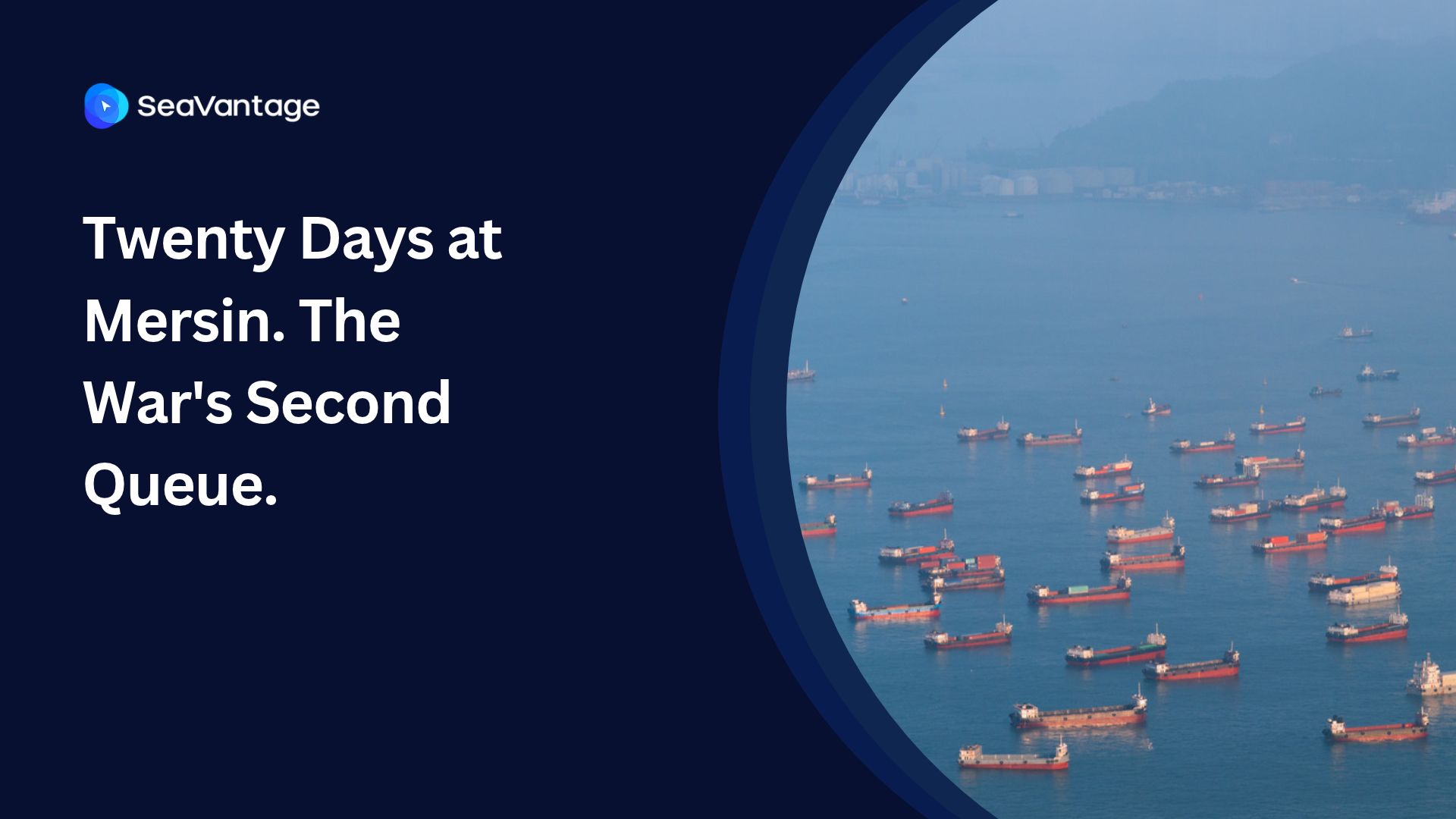
Cargo bound for the Gulf now waits up to 20 days at Turkey's Mersin port. Demand runs 30–40% past capacity. What shippers can do about it.

No single ETA is reliable alone. Reliability comes from carrier ETA plus an independent predicted arrival, live AIS, and port waiting data.


