


How to Read SeaVantage’s PTA & Carrier ETA: 5 Real-World Scenarios Every Supply Chain Professional Should Know

Every freight forwarder knows the feeling: the carrier's ETA hasn't moved, but something feels off. That instinct now has data behind it — PTA, Predicted Time of Arrival.
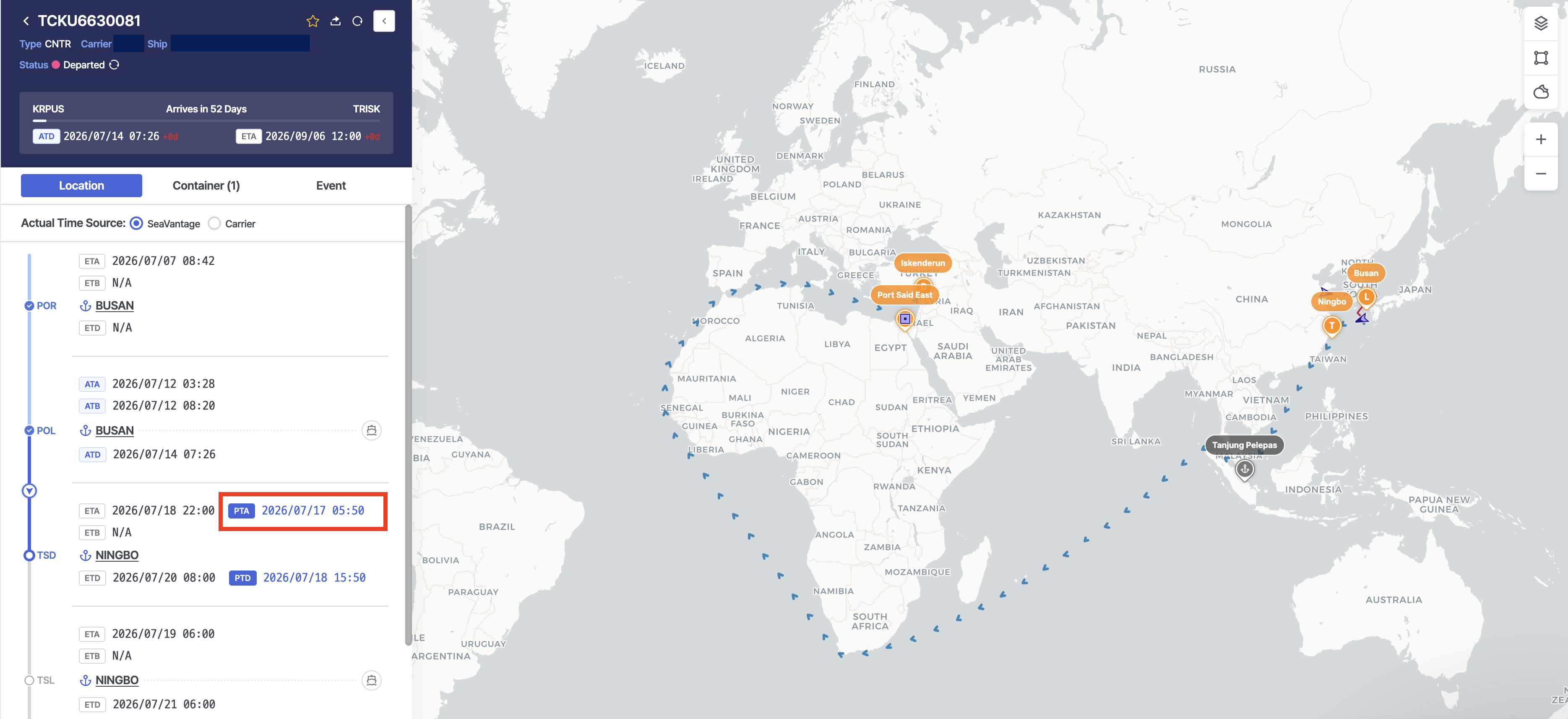
PTA is SeaVantage's real-time prediction layer, built to work alongside the carrier's official ETA, not replace it. And unlike a single arrival estimate for the whole voyage, Cargo Insight tracks PTA and ETA independently at every leg of the journey: the port of loading, each transshipment call, and the final discharge port.
This guide shows you how to read PTA against ETA, leg by leg, and what to do at each stage of the voyage.
A 30-Second Refresher: PTA, ETA, and Why Both Matter
- PTA (Predicted Time of Arrival): SeaVantage's data-driven prediction, built from AIS position, vessel speed, routing patterns, port congestion, and historical lane behavior. It updates continuously, near real time — and it's tracked separately for every leg of the voyage.
- ETA (Estimated Time of Arrival): The carrier's official arrival estimate — the baseline your team, customers, and partners plan around.
- ATA (Actual Time of Arrival): What actually happens.
ETA and PTA look like the same kind of number — a date and time. They're not. ETA is an official commitment. PTA is a real-time predictive signal. Carrier ETAs remain the trusted baseline — they're official, and carrier reliability keeps improving industry-wide. But official updates can lag behind what's happening on the water. That lag isn't "the carrier being wrong." It's a timing gap, and PTA exists to narrow it — leg by leg, not just once per voyage.
One Voyage, Multiple Legs — A PTA for Each
Take a real shipment moving from Chennai to Busan. The carrier's overall voyage ETA is set weeks out. But the voyage isn't one leg — it's several: departure from the port of loading, a transshipment call, and the final approach to the discharge port. Cargo Insight tracks ETA and PTA separately at each one.
On the transshipment leg into Singapore, for example, the carrier's ETA might read 06:00, while the PTA — built from the vessel's live position and speed — reads 04:00. Two hours apart, on a single leg, days before that leg even happens.
That's the value PTA adds: not one number for the whole voyage, but a live, leg-by-leg comparison against the carrier's schedule everywhere it matters — including the transshipment ports, where delays are hardest to see coming and most likely to cascade into the rest of the journey.
PTA and ETA: Quick Reference
Whether you're looking at a single leg or the full voyage, here's how to translate what PTA and ETA are telling you into action:
Here's what that looks like in practice, leg by leg.
Scenario 1: ETA ≈ PTA — "Nothing to Do Here, and That's Good News"
The situation: Priya manages inbound logistics for a mid-size electronics importer. A container from Ho Chi Minh City is three days out. The carrier's ETA hasn't moved in over a week. The PTA — tracking the vessel's actual position, speed, and routing — sits within a few hours of it.
What it suggests: When ETA and PTA agree, the official plan and the predictive signal tell the same story. No hidden risk is building.
What to do: Nothing — and that's the point. Priya keeps the trucking booking, dock slot, and delivery window exactly as planned. "Nothing's wrong" is itself a useful signal: it tells her where not to spend attention, freeing her team to focus on shipments that need it.
Scenario 2: PTA Trending Later Than ETA — "The Early Warning Window"
The situation: Daniel runs operations at a freight forwarder handling multiple Northeast Asia lanes. On one shipment, the carrier's ETA has held at Thursday for over a week. Over the last 48 hours, the PTA has crept later — six hours, then twelve more — while the official ETA hasn't moved.
What it suggests: This is the classic early-warning pattern. The vessel's real-world signals — speed, position, routing — are shifting before the carrier's official update catches up. This isn't PTA being "more accurate." It's PTA surfacing a possible delay before it becomes official — the exact lead time this signal is built to provide.
What to do: Daniel doesn't cancel anything — the ETA hasn't officially changed. He uses PTA's early signal to pre-check, not react:
- Flags the trucking partner that the window might shift, without cancelling the booking.
- Tells the warehouse to hold flexibility in the dock schedule.
- Drafts — but doesn't send — a proactive note to the customer.
If the ETA later updates to match the PTA trend, Daniel's team is three steps ahead instead of scrambling. That's what PTA is for: turning a surprise into a checklist.
Scenario 3: ETA Repeatedly Revised Later — "When the Baseline Itself Gets Shaky"
The situation: Mira, a supply chain planner for a BCO importing seasonal retail goods, spots a different pattern: not a single PTA-ETA disagreement, but the carrier's own ETA pushed back three times in ten days — Tuesday, then Thursday, then the following Monday.
What it suggests: This differs from a one-time PTA divergence. When the official baseline itself keeps moving, it signals rising operating uncertainty upstream — congestion, weather, schedule recovery, or knock-on effects from earlier delays. No single ETA update is wrong; the pattern of repeated revision is what matters.
What to do: Mira shifts the shipment into conservative planning mode:
- Builds buffer days into downstream commitments instead of planning to the latest ETA.
- Flags the SKU to merchandising as at-risk, instead of waiting for a fourth revision.
- Treats every future update — official or predicted — with a wider margin of error until the pattern stabilizes.
A single delay is a data point. A repeated pattern is a trend — and trends call for a different planning posture, not just a schedule adjustment.
Scenario 4: PTA Swinging Significantly — "Volatility Is the Message, Not the Number Itself"
The situation: A forwarder tracking a long-haul transpacific shipment watches the PTA swing in both directions over several days — earlier, then later, then earlier again — while the vessel is still mid-voyage.
What it suggests: This volatility shows up on longer transit legs, where more time and more variables — weather routing, speed adjustments, port-calling order — give the predicted arrival room to shift. It isn't PTA "failing." Predictions naturally tighten as a vessel nears port, since fewer variables remain unresolved. Mid-voyage on a long leg is exactly when volatility is expected.
What to do: Treat a swinging PTA as an early warning flag, not a countdown clock. Don't lock in a delivery plan around the latest PTA reading. Instead:
- Widen the range shared internally — "expect this window," not a fixed date.
- Delay firm commitments to downstream partners until the vessel nears port and the signal stabilizes.
- Re-check PTA against ETA more often as the voyage progresses, instead of treating any single reading as final.
Bonus Scenario 5 (Advanced): When the Vessel Arrives, But the Cargo Still Isn't Available
The situation: A consumer goods shipment arrives at port on schedule — ETA and PTA landed close together, which by Scenario 1's logic should mean smooth sailing. Days later, the cargo still hasn't cleared the gate. Berth waiting time, terminal dwell, and inland connection delays have quietly extended the real window before the goods are workable.
What it suggests: Arrival isn't availability. A vessel making port on time answers the ETA/PTA question — not the operational question of when cargo can actually move. One overlooked detail: berth priority and terminal access are set by the carrier operating the vessel, which isn't always the carrier the shipper booked with — especially on vessel-sharing or slot-charter arrangements. Congestion impact can vary by who's running the ship, not just who sold the booking.
What to do: For high-value or time-sensitive cargo, track the full window — arrival, berth wait, and gate-out — instead of closing the loop the moment ETA and PTA converge. Build inland transportation and customer commitments around the realistic workable window, not just the vessel's arrival date.
Make Reading PTA and ETA a Habit, Not a One-Off Check
None of these scenarios require picking a winner between ETA and PTA. They require reading them together, leg by leg — a habit, not a one-time lookup:
- Check every leg, not just the voyage total. Is PTA converging with ETA, diverging, or holding steady — on this leg specifically?
- Match your response to the pattern. A one-time divergence deserves a pre-check. A repeated ETA revision deserves a planning-mode shift. A volatile PTA deserves patience, not a locked-in decision.
- Remember what PTA can't tell you. It flags risk — it doesn't guarantee an outcome. Treat every reading as a signal to act on, not a promise to hold.
The forwarders and shippers who get the most from Cargo Insight aren't chasing a single "more accurate" number. They're the ones reading PTA against ETA at every leg of the journey — and acting early enough that a delay becomes a manageable exception instead of an expensive surprise.
Want to see this on your own live shipments? Cargo Insight tracks PTA and ETA independently at every leg of your voyage — port of loading, transshipment calls, and final discharge — so your team spots risk before the official update catches up.
[Book a demo with SeaVantage →]


팬스타 아크로호가 지난 8월 22일 북극항로 시범운항을 시작했습니다. 국내 최초 컨테이너선 북극항로 운항 현황과 상업성 검증 항목, 화주·포워더가 주목할 사항을 정리합니다.

태풍 발생 시 선박은 우회·감속·대기 등 서로 다르게 대응합니다. AIS 항적과 ETA·PTA·PTB, 항만 혼잡 데이터를 활용해 해상운송 지연 가능성을 판단하는 방법을 알아보세요.

Need a SeaRates alternative? See how SeaVantage Cargo Insight supports container tracking, predicted arrivals, shipment milestones, and API access.

TPEB rates 2026, Indian Subcontinent ocean freight capacity, Strait of Hormuz shipping disruption, schedule reliability ocean carriers

What's driving ocean freight peak season 2026 — rates, surcharges, booking windows, and how to avoid missed inventory deadlines.

.png)


