


RFP Checklist: What to Look for in an Ocean Freight Visibility API
TL;DR
- Evaluating an ocean freight visibility API for a client engagement comes down to six categories: data coverage & accuracy, API & integration, security & compliance, reliability & SLA, deployment fit, and partnership/commercial fit.
- The single most important differentiator isn't whether a vendor shows container locations — it's whether they provide a genuinely predictive arrival time (PTA), not just a carrier ETA passthrough.
- For consulting and systems integration firms specifically, partnership fit matters as much as the technology: does the vendor stay behind the scenes, or will they try to sell directly to your client?
- A printable, condensed version of this checklist is included below for use directly in an RFP document.
- SeaVantage's Cargo Insight, Ship Insight, and Port Insight APIs are built to answer every category on this list. Talk to our Partnerships team →
Why a Formal Checklist Matters Here
Our previous two posts covered why maritime visibility has become a recurring deliverable in supply chain engagements, and why partnering with a specialized provider usually beats building or buying generic tracking. Once a firm reaches that decision, the next step is a formal evaluation — and ocean freight visibility is specialized enough that a generic "vendor evaluation" template misses the details that actually separate a strong partner from a weak one.
This checklist is built for that evaluation. Use it as-is inside an RFP, or pull individual sections into your own vendor scorecard.
How to Use This Checklist
The six categories below are roughly ordered by how often they end up being the deciding factor: data accuracy and integration quality tend to separate vendors quickly, while security, reliability, and commercial fit typically narrow a shortlist down to one. Weight them based on your specific client's priorities — a client in a highly regulated industry may weight security higher; a client with in-house developers may weight API design higher.
1. Data Coverage & Accuracy
This category is where the biggest quality gap between vendors shows up. A vendor that only repeats the carrier's ETA hasn't solved the actual problem: carrier ETAs are known to be unreliable, which is precisely why a client asked for a visibility solution in the first place.
2. API & Integration
For a firm embedding this into client-facing systems, API quality matters more than dashboard polish. A vendor with a beautiful UI but a thin, undocumented API will slow down every integration that follows.
3. Security & Compliance
For engagements with regulated or security-conscious clients, this category can eliminate vendors outright regardless of how strong their data is elsewhere.
4. Reliability & SLA
Because the visibility layer becomes part of your firm's own delivery commitment, the vendor's reliability is effectively your reliability in the client's eyes. Treat this category with the same scrutiny you'd apply to any system your firm's name is attached to.
5. Deployment & Timeline Fit
A vendor that's technically excellent but takes six months to integrate can derail an engagement's timeline just as badly as a vendor with weak data.
6. Partnership & Commercial Fit
This is the category generic vendor-evaluation templates usually miss entirely, and it's often the one that matters most for a firm choosing a long-term technology partner rather than a one-time purchase.
Quick-Reference Checklist
A condensed version for dropping directly into an RFP document:
How SeaVantage Answers This Checklist
For reference, here's how our Cargo Insight, Ship Insight, and Port Insight APIs map to the categories above: multi-source data combining carrier updates with terrestrial, satellite, and vessel-based AIS; a predictive time-of-arrival model rather than a carrier-ETA passthrough; both Core and Extended API tiers with documented endpoints; a 99.9% uptime target backed by enterprise-grade SLA support; and 24/7 expert support. We work directly with consulting and systems integration firms and are built to stay behind the scenes of your client relationship, not compete with it.
Frequently Asked Questions
What's the most important factor when evaluating an ocean freight visibility API?
Whether the vendor provides a genuinely predictive arrival time (PTA) rather than simply passing through the carrier's own ETA. Carrier ETAs are frequently inaccurate, which is usually the core problem a visibility solution is meant to solve — a vendor that only repeats that number hasn't actually solved it.
What security certifications should a visibility API vendor have?
At minimum, look for documented encryption in transit and at rest, and relevant certifications such as SOC 2 or ISO 27001. For regulated or security-conscious clients, also confirm data residency and a documented incident response process.
How long should it take to integrate an ocean freight visibility API into a client engagement?
A well-built, API-first vendor should typically deploy within weeks, not months or quarters. If a vendor's proposed timeline doesn't fit inside your engagement's overall schedule, it's worth treating as a disqualifying factor rather than a minor inconvenience.
Why does it matter whether a vendor has experience working through consulting or SI firms specifically?
Vendors used to selling only direct-to-shipper may not be structured to stay behind the scenes of your client relationship, or to price and support a multi-client, multi-engagement partnership. A vendor with consulting/SI experience is more likely to understand that your firm — not the vendor — owns the client relationship.
Should this checklist be used for every client engagement, or only large ones?
The full checklist is most useful for a formal RFP process. For smaller or faster-moving engagements, the condensed Quick-Reference Checklist above covers the criteria that matter most without the full evaluation overhead.
The Bottom Line
A strong ocean freight visibility vendor should hold up under scrutiny across all six categories above — not just have an impressive dashboard. Use this checklist as a starting point for your next RFP, and weight the categories based on what matters most to your specific client.
SeaVantage partners with consulting and systems integration firms to add container and vessel-level visibility to client engagements — API-first, enterprise-SLA-backed, and built to stay behind the scenes of your client relationship.
Talk to our Partnerships team →

팬스타 아크로호가 지난 8월 22일 북극항로 시범운항을 시작했습니다. 국내 최초 컨테이너선 북극항로 운항 현황과 상업성 검증 항목, 화주·포워더가 주목할 사항을 정리합니다.
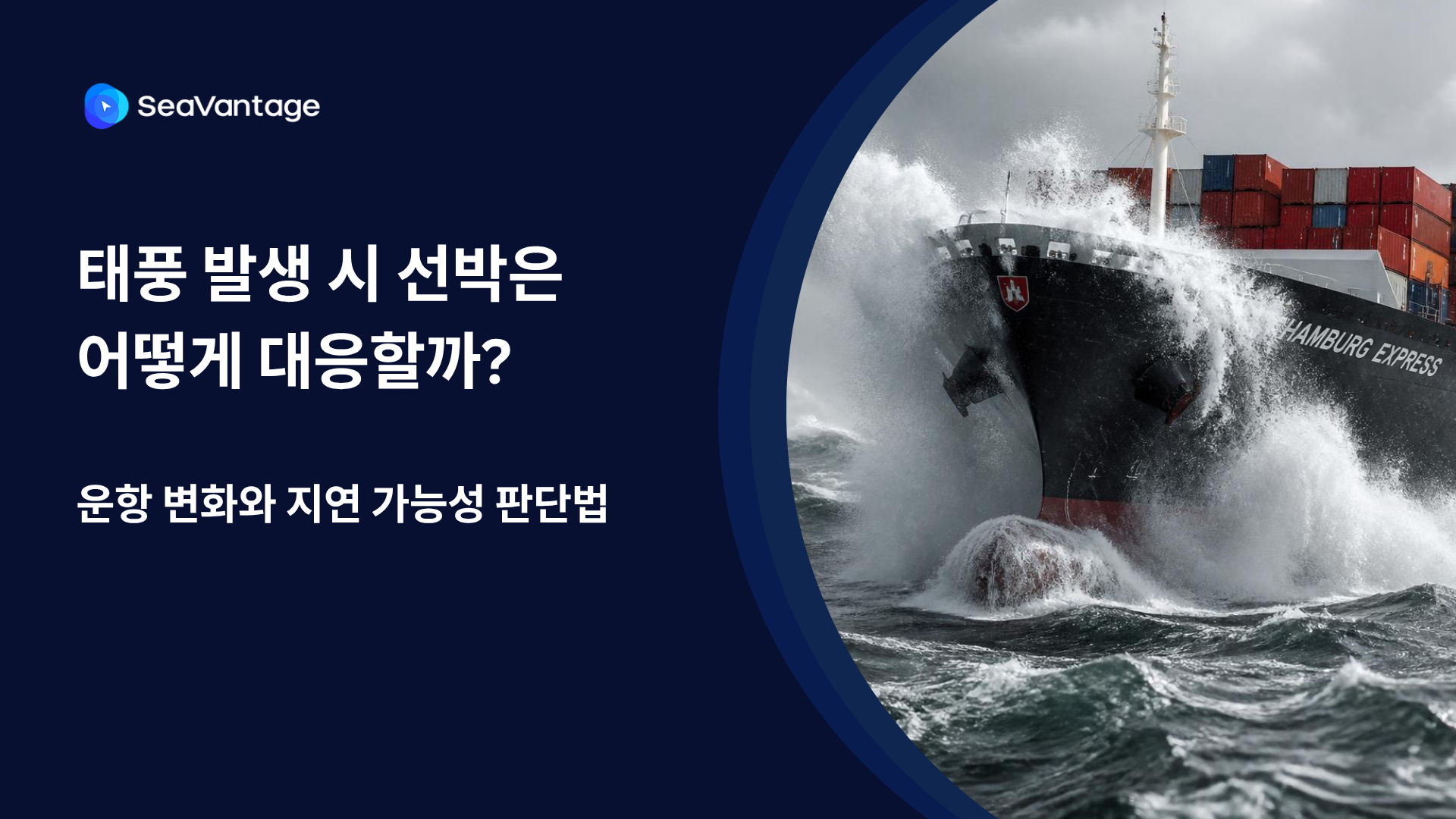
태풍 발생 시 선박은 우회·감속·대기 등 서로 다르게 대응합니다. AIS 항적과 ETA·PTA·PTB, 항만 혼잡 데이터를 활용해 해상운송 지연 가능성을 판단하는 방법을 알아보세요.
Need a SeaRates alternative? See how SeaVantage Cargo Insight supports container tracking, predicted arrivals, shipment milestones, and API access.
TPEB rates 2026, Indian Subcontinent ocean freight capacity, Strait of Hormuz shipping disruption, schedule reliability ocean carriers
What's driving ocean freight peak season 2026 — rates, surcharges, booking windows, and how to avoid missed inventory deadlines.

.png)


