


Navigating the New Normal: 2026 Ocean Freight Outlook & Strategies

Even for seasoned professionals, navigating the currents of global ocean logistics in 2026 feels like a constant battle against volatility. The market today is full of contradictions—easing in one area while tightening in another, with unexpected forces creating new challenges.
As recent market analysis aptly puts it:
"2026 will be a complex landscape for global logistics, defined by market paradoxes and sustained tension."
For supply chain leaders, the big picture often hides the critical details that can break a strategy. To help you navigate this, we have distilled the most impactful takeaways from the latest global ocean freight market data. Here are the four truths you need to understand to stay ahead this year.
1. Weather Is the New "Wild Card" in Ocean Freight
The Trend: Environmental disruption is now a standard operational variable.
Beyond the familiar economic forces of supply and demand, severe weather has emerged as a major operational disruptor for ocean freight. Unpredictable environmental events are creating bottlenecks and delays that ripple through entire supply chains, regardless of economic market conditions.
The impact creates a volatile and shifting map of port congestion. Recent 2026 disruptions include:
- North Europe: Severe winter conditions impacting port and terminal operations.
- Arctic Events: Extreme weather forcing temporary terminal shutdowns.
- Asia-Pacific: High winds causing delays in a wide arc from Korea to Malaysia.
- Port Specifics: Heavy berth congestion at Qingdao, while conditions improve at Ningbo and Shanghai. Meanwhile, Manila faces 3-5 day delays as a residual impact of weather.
The Strategy: Shippers must now account for weather-related disruptions not as "force majeure" anomalies, but as a critical variable in standard logistics planning. Utilizing predictive port visibility tools is no longer optional; it is the only way to anticipate these delays before they impact your inventory.
2. The Fastest Ship Isn't Always the Best Solution
The Trend: Reliability trumps theoretical speed.
In a tight ocean market, the instinct is often to secure space on the first available vessel to get goods moving. However, in 2026, this common strategy is often a misconception.
With ocean transit times currently ranging between 40 and 60 days, the "first available departure" is not guaranteed to be the fastest arrival. A vessel with a slightly later departure date but a better on-time performance record may actually deliver your cargo sooner than an earlier sailing prone to delays.
The Strategy: This represents a crucial trade-off between speed and certainty. Prioritizing the predictability of a confirmed booking over the mere chance of an earlier departure (which carries a high risk of being "rolled") is key to building a reliable supply chain. Book cargo 3-4 weeks in advance to secure these reliable slots.
3. Size Matters: The Strategic Advantage of Smaller Lots
The Trend: Agility beats volume in congested lanes.
While consolidating shipments is traditionally seen as a cost-saving measure, 2026's volatile capacity environment has flipped the script. Large bookings are increasingly vulnerable to being rolled or split, especially during peak congestion or weather events.
Carriers facing capacity constraints are more likely to load smaller, more manageable lots than large block bookings that require significant contiguous space.
Recommended Booking Tactics:
- Book Small Lots: Keep shipments under 2-4 TEUs.
- Split Bookings: If you have large volume, split it across multiple Bills of Lading or even different vessels.
The Strategy: Breaking down your volume improves the probability of loading. It is a defensive strategy that sacrifices a small amount of administrative simplicity for a massive gain in supply chain reliability.
4. Your Company Might Be Leaving a Fortune on the Table
The Trend: Unclaimed import duties are a silent leak in profitability.
One of the most surprising insights for 2026 has nothing to do with containers or vessels, but with unclaimed capital. According to US Customs and Border Protection (CBP), an estimated US$7 Billion in import duties go unclaimed by businesses annually.
This money can potentially be recovered through the US Duty Drawback program. This program allows for the recovery of duties paid on ocean imports in the previous five years—including Section 301 and 232 tariffs—under specific circumstances.
Eligibility Checklist:
- Does your company have a US presence?
- Do you pay duties on imports?
- Do you subsequently re-export, return, or scrap the imported products (including items used in manufacturing)?
The Strategy: If you checked all three boxes, you need to ask: Are we leaving money on the table? Conducting a drawback assessment should be a priority for your finance and logistics teams this quarter.
Data Visibility is Your Best Defense
Successfully navigating today's complex ocean logistics landscape requires looking beyond surface-level trends. The key is to understand the paradoxes at play—from weather volatility masking as congestion to the strategic advantage of smaller, more reliable shipments.
By identifying these hidden truths and opportunities, businesses can build more resilient and efficient supply chains. As volatility becomes the new constant, how will your business adapt its ocean strategy to not just survive, but thrive in 2026?
FAQ: 2026 Ocean Freight Outlook & Strategies
How is weather affecting ocean freight in 2026?
Weather has become a primary disruptor. In early 2026, we are seeing severe delays in North Europe and parts of Asia (Korea, Malaysia, Qingdao) due to winter storms and high winds, making real-time port monitoring essential.
Why should I split my ocean bookings?
In a volatile market, large bookings are more likely to be "rolled" (delayed) by carriers. Keeping shipments under 2-4 TEUs increases the likelihood of your cargo getting loaded on the intended vessel.
What is the Duty Drawback program?
It is a US Customs program allowing businesses to recover up to 99% of duties paid on imported goods that are later exported or destroyed. An estimated $7 billion goes unclaimed annually.

팬스타 아크로호가 지난 8월 22일 북극항로 시범운항을 시작했습니다. 국내 최초 컨테이너선 북극항로 운항 현황과 상업성 검증 항목, 화주·포워더가 주목할 사항을 정리합니다.
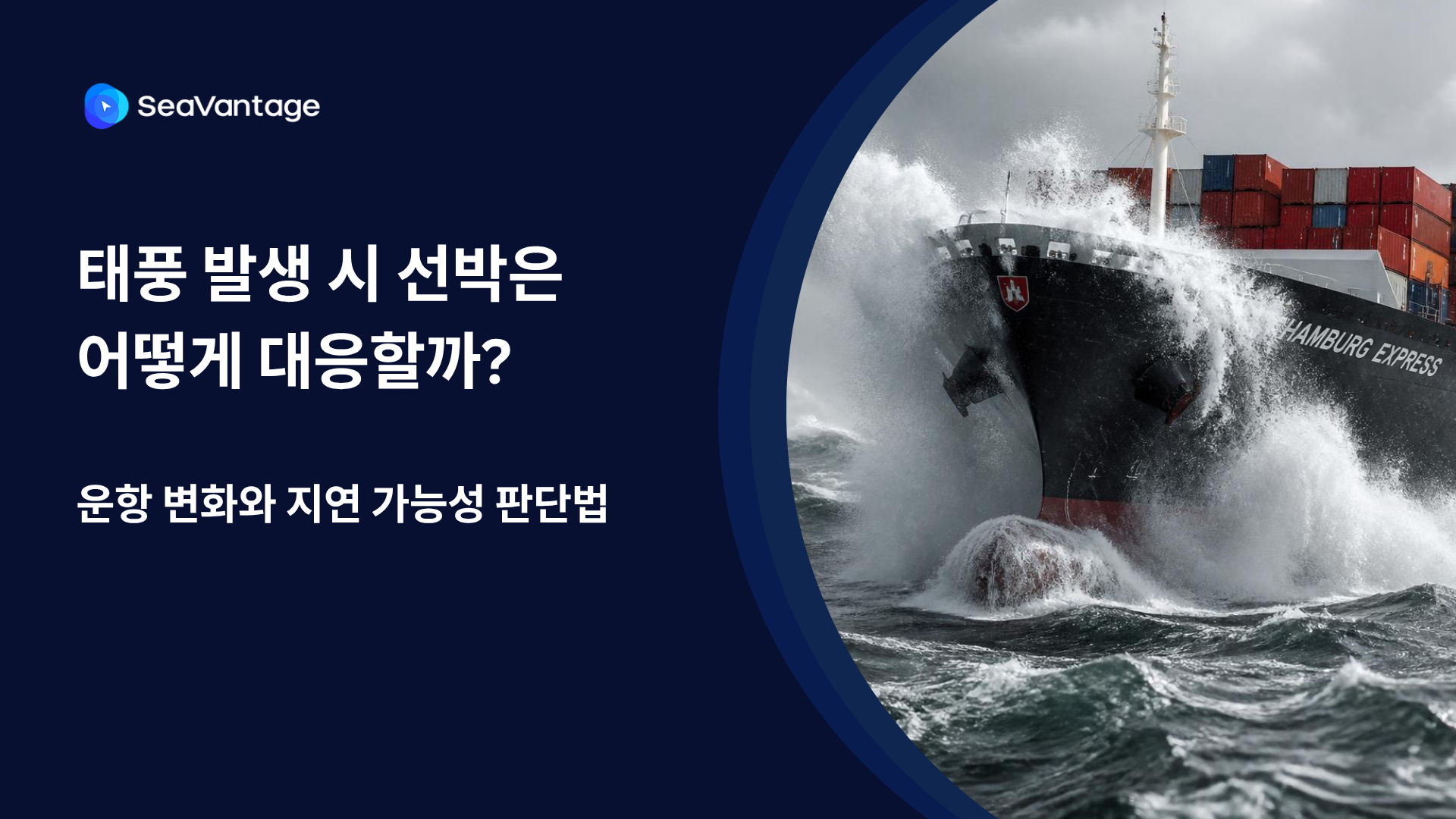
태풍 발생 시 선박은 우회·감속·대기 등 서로 다르게 대응합니다. AIS 항적과 ETA·PTA·PTB, 항만 혼잡 데이터를 활용해 해상운송 지연 가능성을 판단하는 방법을 알아보세요.
선사 ETA가 바뀌기 전에 일정 변동 가능성을 미리 파악할 수 있을까요? PTA와 ETA의 차이, 구간별 확인 방법, 실무 대응 시나리오 5가지를 소개합니다.
Need a SeaRates alternative? See how SeaVantage Cargo Insight supports container tracking, predicted arrivals, shipment milestones, and API access.
TPEB rates 2026, Indian Subcontinent ocean freight capacity, Strait of Hormuz shipping disruption, schedule reliability ocean carriers
What's driving ocean freight peak season 2026 — rates, surcharges, booking windows, and how to avoid missed inventory deadlines.

.png)


