


Strait of Hormuz Shipping Disruption: AIS Jamming, Port Shutdowns & Vessel Attacks
Key Takeaways
Shipping operations in the Strait of Hormuz and Persian Gulf are facing a rapidly escalating disruption.
Three critical signals are emerging:
- AIS signals are being jammed and spoofed, causing vessels to disappear from tracking systems or appear in incorrect locations.
- Major regional ports — including Jebel Ali, Abu Dhabi, Doha, and Kuwait — halted operations following US air strikes on Iran, with congestion now building across nearby ports.
- Cargo vessels have reportedly been struck by projectiles while transiting the corridor, increasing operational risk and forcing shipping companies to reassess routing and schedules.
With over 20% of global oil trade passing through the Strait of Hormuz, disruptions in vessel visibility and port operations could ripple across global energy and container supply chains.
SeaVantage maritime analytics indicates that schedule deviations, port omissions, and vessel routing changes are already increasing across container shipping services bound for the Persian Gulf.
The Strait of Hormuz Is Becoming a Supply Chain Blind Spot
The Strait of Hormuz is one of the most strategically important maritime corridors in the world.
Connecting the Persian Gulf with the Arabian Sea, it serves as a critical gateway for global energy shipments and container trade linking Asia, the Middle East, and Europe.
However, recent events are rapidly turning this corridor into a maritime visibility blind spot.
Shipping companies, freight forwarders, and energy traders are now encountering three overlapping disruption signals:
- AIS signal manipulation
- Port shutdowns and congestion
- Security threats to vessels in transit
Each of these factors independently creates operational risk.
Together, they threaten to significantly disrupt maritime supply chain visibility.
Signal #1: AIS Spoofing and Signal Jamming Across the Strait
Automatic Identification System (AIS) signals are the backbone of modern vessel tracking.
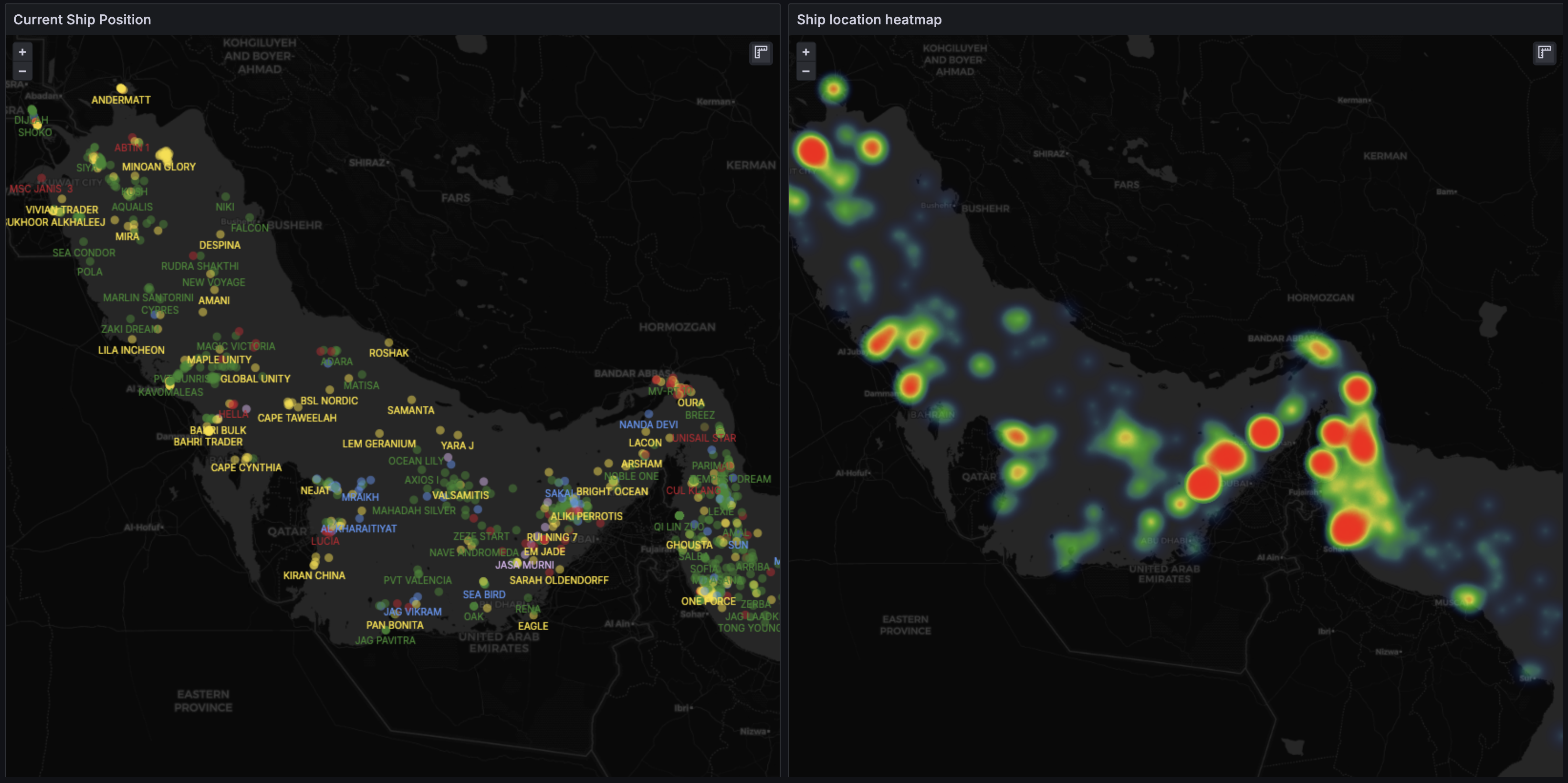
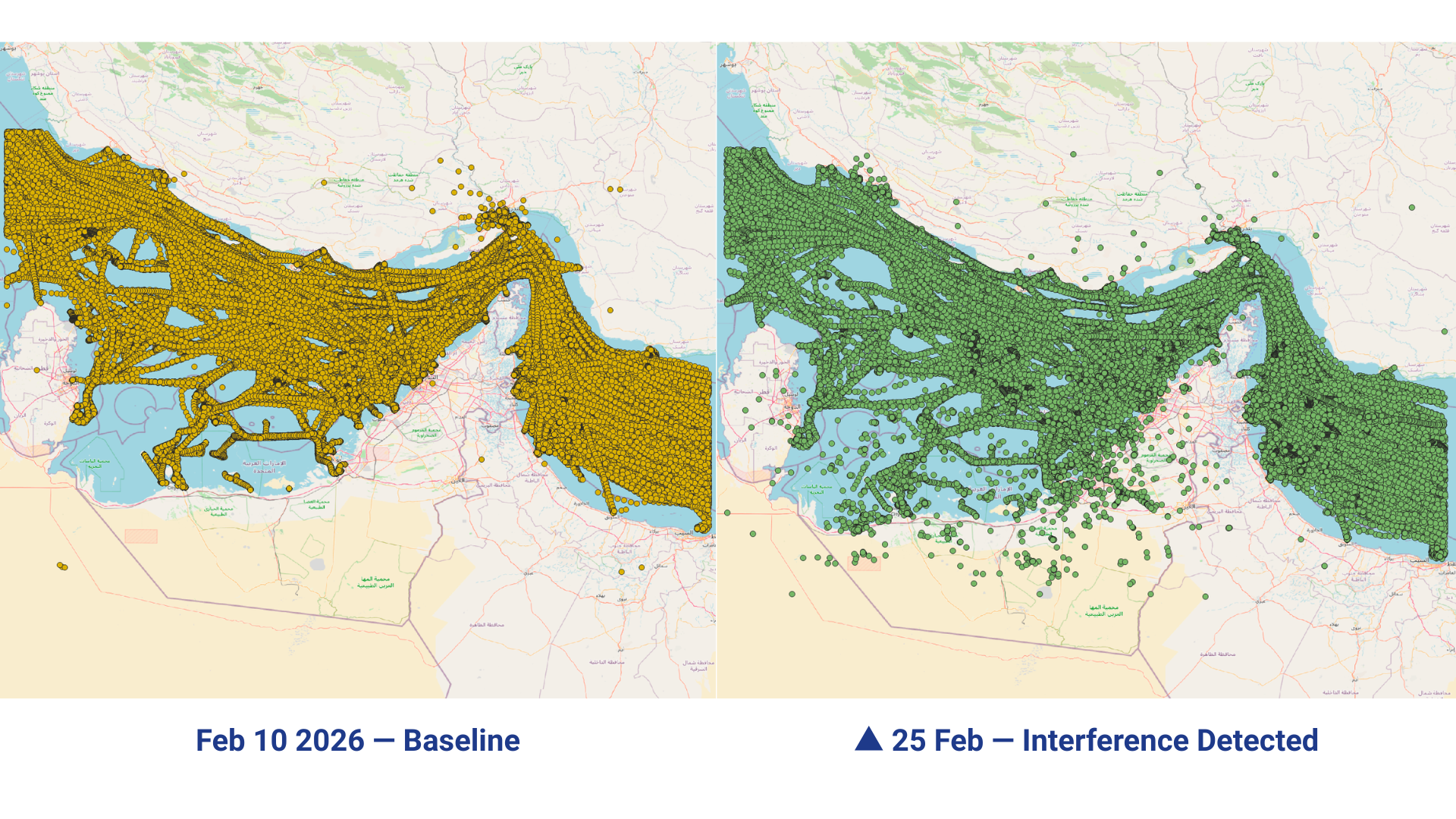
But across the Strait of Hormuz, shipping analytics platforms are detecting increasing signs of AIS spoofing and signal interference.
This includes anomalies such as:
- Ships appearing on land or at incorrect coordinates
- Vessel signals suddenly disappearing
- AIS tracks showing impossible navigation patterns
When AIS signals are corrupted or manipulated, traditional vessel tracking platforms can no longer provide reliable location data.
For supply chain operators, this creates a serious problem:
- Cargo positions become uncertain
- Estimated arrival times become unreliable
- Operational planning becomes reactive instead of predictive
In high-risk regions like the Strait of Hormuz, this visibility gap can quickly cascade into port congestion, missed schedules, and delayed cargo deliveries.
Signal #2: Persian Gulf Port Shutdowns Trigger Regional Congestion
In addition to AIS disruptions, the region is experiencing significant port operational impacts.
Following US air strikes on Iran, several major ports across the Persian Gulf temporarily halted operations, including:
- Jebel Ali Port (UAE)
- Abu Dhabi
- Doha
- Kuwait
While some ports have since resumed activity, vessel arrivals remain limited, and operational backlogs are growing.
This is already leading to several emerging supply chain effects:
- Congestion building at Persian Gulf terminals
- Delayed berthing windows
- Spillover congestion reaching nearby ports in India and wider Asian networks
For container shipping lines, these disruptions often lead to schedule omissions or rerouted services, which can ripple through entire shipping networks.
Signal #3: Vessel Security Risks in the Shipping Corridor
Compounding the operational disruption, cargo vessels have reportedly been struck by unknown projectiles while transiting the Strait of Hormuz.
While details remain limited, these incidents significantly alter the risk profile of the corridor.
For shipowners and operators, this creates new operational challenges:
- Increased insurance and security considerations
- Potential route deviations
- Changes to transit speeds or waiting areas
Most importantly, when AIS visibility is compromised at the same time, operators lose one of their most important tools for monitoring vessel movement and risk exposure.
How Shipping Behaviour Is Already Changing
While much attention is focused on energy shipping, container shipping behavior in the region is also beginning to shift.
Early maritime analytics signals indicate:
1. Schedule Deviations
Container vessels originally scheduled to call at Jebel Ali and Khalifa Port are beginning to show:
- Schedule adjustments
- Port omissions
- Changes in arrival sequencing
These changes often occur quietly in carrier schedule updates but can significantly impact downstream logistics planning.
2. Liner vs Non-Liner Vessel Behaviour
Another emerging pattern involves differences between:
- Liner container vessels
- Non-liner cargo vessels
Early analysis suggests that vessel classes with long-term calling history in the Persian Gulf may respond differently to rising risk levels, particularly when schedule commitments and service networks are involved.
Understanding these behavioural patterns is essential for predicting how disruptions will propagate across global trade lanes.
Why Maritime Visibility Matters Now More Than Ever
The Strait of Hormuz is not just a regional shipping lane.
It is a global supply chain chokepoint.
According to energy trade estimates, more than 20% of global oil shipments pass through this corridor. Container shipping routes serving the Middle East, South Asia, and parts of Europe also depend heavily on this passage.
When visibility breaks down in such a critical corridor, supply chain operators face several risks:
- Inaccurate ETAs
- Delayed cargo delivery
- Congestion spreading across port networks
- Reduced ability to respond to disruptions
This is why advanced maritime analytics and AIS anomaly detection are becoming increasingly critical for logistics operations.
How SeaVantage Maintains Vessel Visibility During AIS Disruptions
SeaVantage applies advanced maritime analytics to maintain vessel tracking even when traditional AIS systems become unreliable.
Key capabilities include:
AIS Signal Filtering
SeaVantage identifies and removes corrupted or manipulated AIS signals, helping restore accurate vessel positioning.
Maritime Traffic Network Analysis
Historical vessel movement patterns are used to validate and reconstruct likely vessel routes when live AIS signals are unreliable.
Predictive ETA Intelligence
By combining historical data with real-time signals, SeaVantage improves ETA predictions even when AIS coverage is disrupted.
This allows logistics teams to maintain operational awareness during high-risk maritime events.
Monitoring the Strait of Hormuz in Real Time
As disruptions continue to evolve, maintaining live operational visibility is critical for supply chain decision-making.
SeaVantage is currently monitoring:
- AIS disruption patterns across the Strait
- Vessel routing changes
- Container schedule deviations
- Congestion signals across Persian Gulf ports
You can explore the live maritime disruption dashboard here:
Open Live Disruption Dashboard →
https://devops.seavantage.com/public-dashboards/84f94499577045b2bdd5648d9747fc87
(No login required.)
The Bottom Line
The Strait of Hormuz is entering a period of heightened maritime uncertainty.
AIS signal disruptions, port shutdowns, and rising vessel security risks are combining to create one of the most significant maritime visibility challenges in recent years.
For shipping operators, freight forwarders, and global logistics teams, maintaining reliable vessel tracking in this region is becoming critical to protecting supply chain operations.
As the situation develops, data-driven maritime intelligence will play an increasingly important role in navigating disruptions.

팬스타 아크로호가 지난 8월 22일 북극항로 시범운항을 시작했습니다. 국내 최초 컨테이너선 북극항로 운항 현황과 상업성 검증 항목, 화주·포워더가 주목할 사항을 정리합니다.
태풍 발생 시 선박은 우회·감속·대기 등 서로 다르게 대응합니다. AIS 항적과 ETA·PTA·PTB, 항만 혼잡 데이터를 활용해 해상운송 지연 가능성을 판단하는 방법을 알아보세요.
Need a SeaRates alternative? See how SeaVantage Cargo Insight supports container tracking, predicted arrivals, shipment milestones, and API access.
TPEB rates 2026, Indian Subcontinent ocean freight capacity, Strait of Hormuz shipping disruption, schedule reliability ocean carriers
What's driving ocean freight peak season 2026 — rates, surcharges, booking windows, and how to avoid missed inventory deadlines.

.png)


