


Red Sea Ports: Full List, Trade Data & 2026 Disruptions Guide

Key Takeaways
- The Red Sea–Suez corridor handles ~10–15% of global trade, making it one of the world’s most critical shipping arteries.
- Core hub ports include Jeddah Islamic Port, King Abdullah Port, Ain Sokhna Port, and Port of Djibouti.
- Ongoing disruptions (security risks, rerouting) have caused volume drops of up to 83% at some Red Sea ports.
- At the same time, regional shifts are redistributing cargo flows, increasing pressure on alternative ports and routes.
- Real-time visibility, predictive ETAs, and multi-port intelligence are now mission-critical for supply chain resilience.
Why Red Sea Ports Matter More Than Ever
The Red Sea has always been a strategic artery for global trade, but recent developments have elevated its importance from “critical” to “system-defining.” Any disruption in this corridor has immediate ripple effects across Europe–Asia trade lanes, impacting everything from transit times to freight rates and inventory planning.
What makes this region uniquely sensitive is its structural dependency on narrow chokepoints. At the southern end lies the Bab el-Mandeb Strait, while the northern gateway is controlled by the Suez Canal. Together, these two points compress a massive volume of global trade into a highly constrained geographic space. When disruptions occur—whether from geopolitical tensions, vessel incidents, or AIS interference—they don’t stay local. They propagate across entire shipping networks.
In 2026, this has led to a shift in how logistics teams approach planning. Static routing assumptions have broken down. Instead, companies are now operating in a state of continuous recalibration, where port-level intelligence is just as important as ocean-level visibility.
Major Red Sea Ports and Their Strategic Roles
Saudi Arabia: The Region’s Operational Backbone
Saudi Arabia’s western coastline hosts some of the most important ports in the Red Sea, with Jeddah Islamic Port serving as the primary gateway for imports and transshipment. Its scale and connectivity make it a central node in global liner networks, particularly for cargo moving between Asia and the Middle East.
Further north, King Abdullah Port represents a new generation of port infrastructure. Built with automation and scalability in mind, it has increasingly absorbed overflow volumes during periods of disruption. Meanwhile, industrial ports such as Yanbu Industrial Port play a crucial role in energy exports, linking maritime logistics directly with global energy markets.
What’s notable in the current environment is how these ports are being used not just as endpoints, but as dynamic balancing nodes. Cargo that would traditionally move through other corridors is now being redirected, increasing both throughput and operational complexity.
Egypt: The Suez Gateway Layer
Egypt’s Red Sea ports function as the immediate interface with the Suez Canal, making them uniquely sensitive to upstream disruptions. Ain Sokhna Port has emerged as a critical hub due to its integration with inland logistics corridors and industrial zones.
When vessel flows through the Suez Canal fluctuate, Ain Sokhna often becomes a pressure valve—either absorbing excess volume or experiencing sharp declines depending on routing decisions. Nearby facilities such as Port of Suez and Safaga Port contribute to this ecosystem, supporting bulk, container, and regional trade flows.
In practical terms, this means that monitoring Egyptian ports provides early signals of broader network changes. Shifts in vessel arrivals here often precede congestion or delays further downstream.
Djibouti: Control at the Chokepoint
Positioned at the entrance to the Bab el-Mandeb Strait, Port of Djibouti has become one of the most strategically important logistics hubs in the world. Its role extends beyond maritime operations; it serves as a critical gateway for landlocked Ethiopia and a transshipment node for East Africa.
Facilities such as Doraleh Container Terminal and Doraleh Multipurpose Port enhance its capacity to handle diverse cargo types. However, its true importance lies in its geographic leverage. Any disruption at the Bab el-Mandeb Strait immediately elevates Djibouti’s role as both a monitoring point and an operational buffer.
Other Strategic Ports Across the Region
While larger hubs dominate volume, smaller and regional ports continue to play important supporting roles. Port of Aqaba provides Jordan with its only maritime access, making it essential for national supply chains. Port Sudan remains the primary trade gateway for Sudan, while ports in Eritrea and Yemen—including Port of Hodeidah—carry significant geopolitical and operational weight despite current instability.
In times of disruption, these ports often transition from secondary roles to critical alternatives, reinforcing the need for comprehensive, region-wide visibility.
2026 Disruptions: A Structural Shift, Not a Temporary Shock
What distinguishes the current situation from past disruptions is its persistence and complexity. This is not a single event but a convergence of factors—security risks, rerouting decisions, and data inconsistencies—that are reshaping how shipping networks operate.
Carriers are increasingly rerouting vessels around the Cape of Good Hope, effectively bypassing the Red Sea. While this avoids immediate risk, it introduces longer transit times and creates imbalances in port arrivals globally. At the same time, ports within the Red Sea are experiencing uneven demand. Some are seeing sharp declines in vessel calls, while others are dealing with sudden congestion spikes due to diverted cargo.
This dual dynamic—decline in some nodes and overload in others—makes traditional planning models ineffective. It’s no longer enough to track whether a vessel will arrive. The critical question is how the entire network is shifting in response to disruption.
The Visibility Gap: Why Most Supply Chains Struggle
Despite advancements in tracking technology, many logistics teams still operate with fragmented data. AIS signals may be delayed or manipulated, port updates can lag behind actual conditions, and static schedules fail to reflect real-world variability.
This creates a visibility gap where decisions are made based on outdated or incomplete information. In a stable environment, this might be manageable. In the Red Sea today, it becomes a significant operational risk.
The companies that are adapting successfully are those that have shifted from point visibility (tracking a vessel) to network intelligence (understanding how ports, routes, and vessels interact in real time).
How SeaVantage Enables Real-Time Decision Making
SeaVantage is designed to address exactly this level of complexity. Instead of treating ports and vessels as isolated data points, it builds a unified view of maritime activity across regions like the Red Sea.
By combining real-time vessel tracking with predictive ETA modeling, SeaVantage allows logistics teams to anticipate delays before they happen. More importantly, it provides context—highlighting how congestion in one port may impact downstream operations or how rerouting decisions are reshaping carrier networks.
This shift from reactive tracking to proactive intelligence is what enables better routing decisions, more accurate planning, and ultimately, more resilient supply chains.
Strategic Takeaways for Freight Forwarders, BCOs, and 3PLs
The Red Sea is no longer a corridor you simply pass through—it’s a region you actively manage. Companies that continue to rely on static planning assumptions will struggle to keep up with the pace of change.
Instead, the focus should be on building flexibility into operations. This includes diversifying routing strategies, monitoring secondary ports that may become critical during disruptions, and investing in tools that provide real-time, predictive visibility.
The goal is not to eliminate uncertainty—that’s no longer possible. The goal is to respond to it faster and more intelligently than competitors.
Final Thought
The Red Sea has become a proving ground for modern supply chains. It exposes the limitations of traditional logistics models while highlighting the value of real-time intelligence.
In this environment, visibility is not just about knowing where your cargo is. It’s about understanding what happens next—and acting on it before it impacts your operations.

팬스타 아크로호가 지난 8월 22일 북극항로 시범운항을 시작했습니다. 국내 최초 컨테이너선 북극항로 운항 현황과 상업성 검증 항목, 화주·포워더가 주목할 사항을 정리합니다.
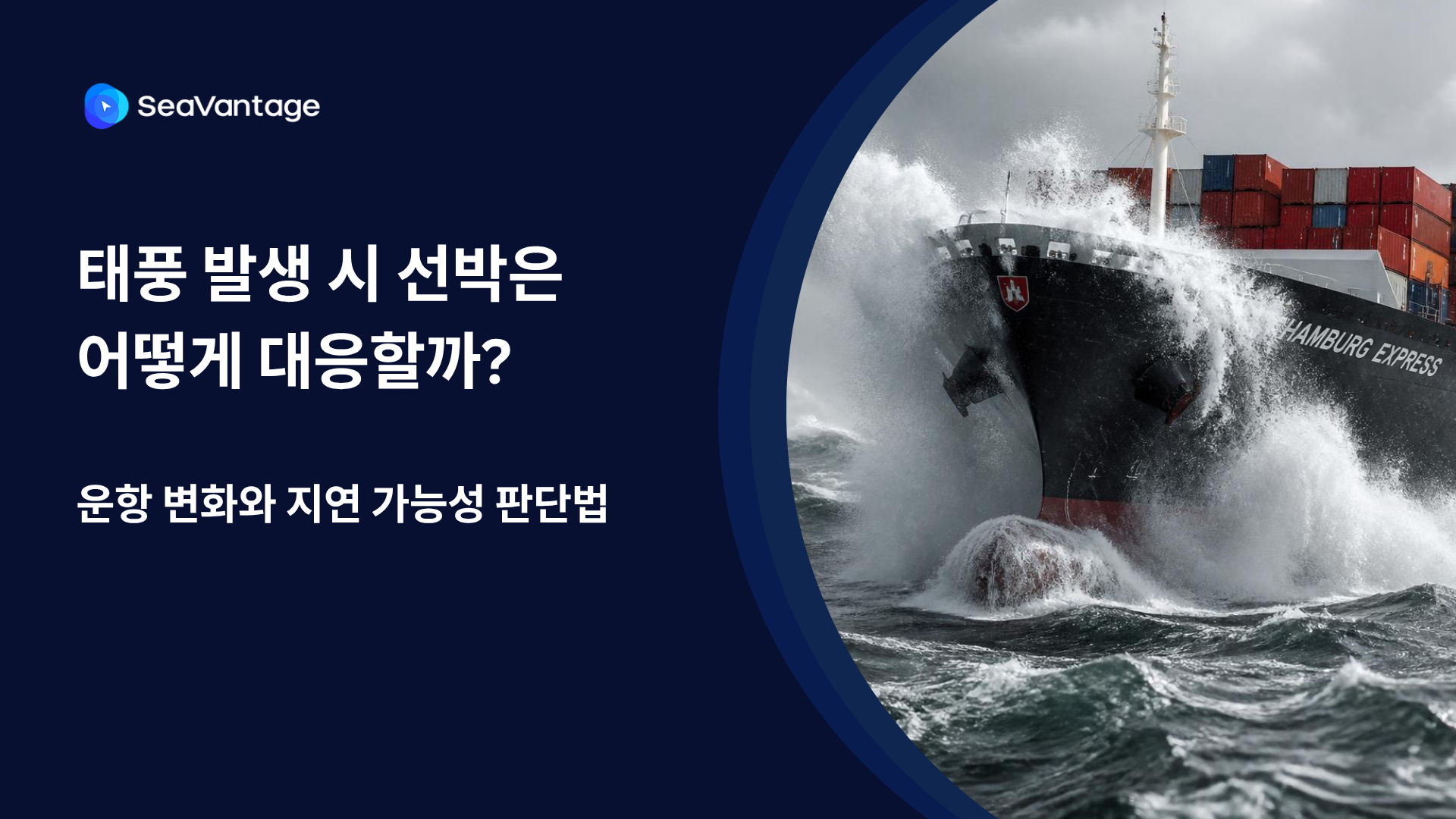
태풍 발생 시 선박은 우회·감속·대기 등 서로 다르게 대응합니다. AIS 항적과 ETA·PTA·PTB, 항만 혼잡 데이터를 활용해 해상운송 지연 가능성을 판단하는 방법을 알아보세요.
선사 ETA가 바뀌기 전에 일정 변동 가능성을 미리 파악할 수 있을까요? PTA와 ETA의 차이, 구간별 확인 방법, 실무 대응 시나리오 5가지를 소개합니다.
Need a SeaRates alternative? See how SeaVantage Cargo Insight supports container tracking, predicted arrivals, shipment milestones, and API access.
TPEB rates 2026, Indian Subcontinent ocean freight capacity, Strait of Hormuz shipping disruption, schedule reliability ocean carriers
What's driving ocean freight peak season 2026 — rates, surcharges, booking windows, and how to avoid missed inventory deadlines.

.png)


