


Best Container Tracking Software in 2026: 8 Platforms Compared
TL;DR — The Short Version
• Container tracking in 2026 is no longer about "can you find my box." Every serious platform pulls AIS, terminal, and carrier data — the differentiation is what they do with it.
• We compared 8 platforms across event coverage, ETA accuracy, integration depth, and price-to-value: SeaVantage, project44, FourKites, Terminal49, Vizion, GoComet, Portcast, and BuyCo.
• SeaVantage leads on AI-driven ETA accuracy and predictive port-level intelligence — the layer most platforms still report after the fact.
• Best for enterprise BCOs with deep TMS stacks: project44, FourKites. Best for forwarders & mid-market: SeaVantage, Terminal49, GoComet. Best for developer-first teams: Vizion. Best for shipper-side workflow: BuyCo.
• If your visibility tool only shows you where your container is right now — you've already lost 48 hours.
Container tracking software in 2026 is a crowded market —and a confusing one. Vendor pages all use the same vocabulary (real-time, AI, predictive, end-to-end) and the same hero numbers. Buyers end up choosing on price or relationships rather than fit.
This guide cuts through that. We've compared the eight platforms shippers, BCOs, and forwarders are actually evaluating in 2026 —using a single framework we call the Visibility Maturity Ladder. By the end, you should know exactly which tier you're buying for, and which platform fits.
The Visibility Maturity Ladder: Pick the Tier Before You Pick the Vendor
Every container tracking platform sits somewhere on this four-tier ladder. The mistake most teams make is buying a Tier 4 platform for a Tier 1 problem — and paying enterprise prices for features they never activate.
Most platforms claim Tier 4. Few deliver above Tier 2 reliably. Here's where each one actually lives.
1. SeaVantage — Best Maritime Intelligence & Predictive Visibility
Tier coverage: Strong at Tier 1–3; Tier 4 via API/EDI.
SeaVantage positions itself as a single source of truth for container tracking by providing end-to-end container intelligence powered by predictive analytics. Instead of relying solely on standard carrier milestones, the platform utilizes dual-source data intelligence. It validates and enhances carrier-reported events using real-time satellite tracking and AIS validation. At its core is a patented Maritime Traffic Network (MTN) and AI-driven models that deliver highly accurate ETAs, routing insights, and disruption signals. Because standard carrier ETAs often fluctuate, SeaVantage’s proprietary algorithms analyze historical vessel performance and weather patterns to deliver a more reliable Predicted Time of Arrival (PTA) that teams can confidently plan operations around.
Where it stands out: SeaVantage goes beyond basic tracking with its Operational Intelligence Center, providing a newly introduced Cargo Report feature dedicated to real-time demurrage visibility. This empowers operations teams to manage dwell time, identify risks for containers approaching demurrage, and stop avoidable costs before they accrue. Additionally, the platform solves external communication bottlenecks through its new "Share Shipment Updates" feature, which generates secure tracking links for external parties without requiring system logins, effectively eliminating "Where is my cargo?" emails.
Best for
• Forwarders, BCOs, and logistics tech companies needing predictive visibility to proactively inform their customers of unforeseen delays and disruptions.
• Operations teams that need granular demurrage insights, including early warning signals to prioritize urgent shipments and automate the tracking of ATA vs. Gate Out.
• Development teams looking for rapid implementation via lightweight, RESTful APIs with standardized JSON responses, avoiding complex integration drags.
• Mid-market and enterprise shippers requiring scalable, enterprise-grade maritime intelligence that is proven at scale and trusted by companies like Samsung SDS, Hyundai Glovis, and POSCO.
2. project44 — Best Enterprise End-to-End Platform
project44 is the most-cited name in supply chain visibility for a reason: it covers all modes (ocean, air, road, rail, parcel)and integrates deeply with virtually every major TMS, ERP, and order-management system. If you're an enterprise BCO running an ecosystem of SAP, Blue Yonder, and Oracle TMS, project44 is built to plug in.
The trade-offs: implementation timelines tend to run quarters, not weeks. Pricing is enterprise-tier — typically a six-figure starting commitment for serious ocean volume. The platform's depth is also its weight; smaller forwarders and mid-market shippers often find themselves paying for breadth they don't activate.
• Best for: Global enterprises with multi-modal visibility needs and dedicated integration resources.
3. FourKites — Best for Real-Time Multi-Modal Yard & Ocean
FourKites is project44's closest peer — equally enterprise-focused, equally multi-modal, with a particular strength in yard visibility and dynamic ETAs. The Dynamic Yard product remains a differentiator for shippers running heavy DC operations. Ocean coverage has matured significantly over the past two years.
FourKites' AI-driven ETAs are credible, though independent benchmarks vary by lane. Like project44, the price-to-value math works best for shippers who'll activate the platform across multiple modes.
• Best for: Large shippers with significant yard operations or multi-modal complexity.
4. Terminal49 — Best for Forwarders Who Want a Clean API
Terminal49 has built a strong reputation among forwarders and digital-native shippers by doing the boring part well: pulling clean, reliable ocean container events from carriers, terminals, and rail. The product is opinionated, the UI is fast, and the API is well-documented enough that engineering teams can ship integrations in days rather than months.
Where Terminal49 leaves room is the layer above raw events — predictive ETAs and port congestion intelligence are lighter than what SeaVantage or project44 deliver. For teams who want to build their own intelligence on top, that's a feature, not a bug.
• Best for: Forwarders, digital freight platforms, and engineering-led shipper teams.
5. Vizion — Best Developer-First Container Tracking API
Vizion is the most API-native platform in this comparison. There's effectively no UI in the traditional sense — the product is the API. For teams building visibility into their own customer portal, TMS, or proprietary platform, Vizion delivers normalized container events from carriers and terminals with strong uptime and reliable refresh cadence.
This is not a buy for an ops team that wants to log in and look at containers. It is a buy for an engineering team building visibility as a feature of their own product.
• Best for: Platforms embedding ocean visibility into their own product.
6. GoComet — Best for Procurement-Led Visibility
GoComet's positioning differs from most of the field: it pairs container tracking with procurement and rate-management workflows. For shippers whose visibility problem is upstream — tendering, RFQ, and contract execution — GoComet ties tracking to the procurement loop in a way most pure-visibility tools don't.
Tracking quality has improved substantially over the past two years and is now competitive on TPEB and Asia-Europe lanes.
• Best for: Procurement and freight-buying teams who want visibility tied to spend.
7. Portcast — Best for Port-Level Predictive Analytics
Portcast is the closest direct competitor to SeaVantage on the predictive-analytics axis. The platform's port congestion forecasts and vessel ETA models are technically strong, with a particular emphasis on analyst-grade dashboards.
The user experience is built for analysts and operations leadership more than front-line ops staff. For teams that want to consume forecasts via API or executive dashboard, Portcast delivers; for teams that need a unified container-level operating screen, the experience can feel split.
• Best for: Analyst teams and ocean carriers needing predictive port analytics.
8. BuyCo — Best Shipper-Side Workflow Platform
BuyCo is less a tracking tool than a shipper-side ocean execution platform. Container tracking is a feature — alongside booking, documentation, demurrage/detention management, and carrier collaboration. For shippers who want a single workflow surface for the entire ocean lifecycle, BuyCo bundles in a way most visibility-only tools don't.
If pure tracking depth is the primary need, BuyCo is overweighted on workflow features you may not use.
• Best for: Shippers wanting bookings, docs, and tracking on one platform.
How to Choose: A 90-Second Decision Framework
Frequently Asked Questions
What is the best container tracking software in 2026?
There is no single "best" platform — the right answer depends on your visibility maturity tier. For predictive port-level intelligence, SeaVantage leads by providing an enterprise-grade maritime intelligence platform that unifies vessel, container, and port data. It utilizes a patented Maritime Traffic Network (MTN) to predict voyage routes and arrival times. The platform is enterprise-ready, proven at scale, and trusted by 85+ companies, including major players like Samsung SDS and Hyundai Glovis.
How accurate are AI-driven container ETAs?
AI-driven ETAs provide a significant advantage over standard carrier ETAs, which often fluctuate significantly. SeaVantage achieves high accuracy using AI-driven models and its proprietary algorithms, which analyze historical vessel performance and weather patterns. This delivers a more reliable Predicted Time of Arrival (PTA) that operations teams can confidently use for labor and planning. To maintain accuracy, this predictive data and shipment tracking information is updated every 2 hours.
How much does container tracking software cost in 2026?
Pricing ranges from a few dollars per container for API-only platforms (Vizion, Terminal49) to six-figure annual commitments for enterprise platforms (project44, FourKites). Mid-market platforms like SeaVantage, GoComet, and Portcast typically price by container volume tier.
Do I need a tracking platform if my carrier already provides one?
Carrier-provided tracking covers only that carrier's containers, refreshes on the carrier's cadence, and rarely includes terminal or congestion context. A third-party platform normalizes events across carriers, adds predictive intelligence, and feeds your internal systems via a single API. For any shipper with more than one carrier, a third-party platform pays back quickly.
Make Visibility a Competitive Advantage
Container visibility used to be a defensive investment —a way to answer customer questions faster. In 2026, it's an offensive one. The platforms that surface port-level intelligence 48–72 hours ahead of the carrier are the ones that let ops teams reroute, replan, and protect margin in real time.
Want to see how SeaVantage's predictive ocean visibility compares against your current platform? Explore the platform and run your own containers through it.

팬스타 아크로호가 지난 8월 22일 북극항로 시범운항을 시작했습니다. 국내 최초 컨테이너선 북극항로 운항 현황과 상업성 검증 항목, 화주·포워더가 주목할 사항을 정리합니다.
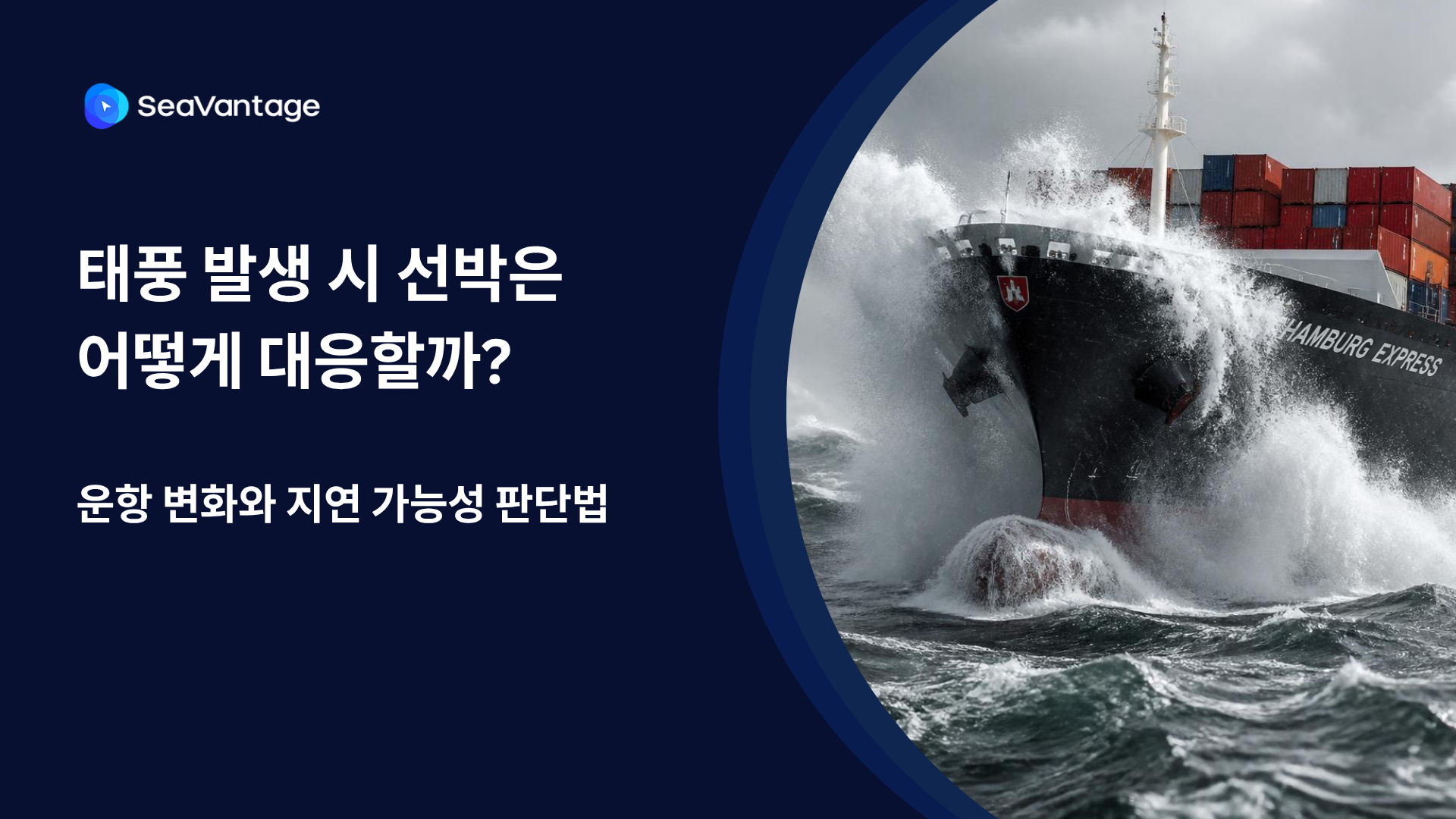
태풍 발생 시 선박은 우회·감속·대기 등 서로 다르게 대응합니다. AIS 항적과 ETA·PTA·PTB, 항만 혼잡 데이터를 활용해 해상운송 지연 가능성을 판단하는 방법을 알아보세요.
Need a SeaRates alternative? See how SeaVantage Cargo Insight supports container tracking, predicted arrivals, shipment milestones, and API access.
TPEB rates 2026, Indian Subcontinent ocean freight capacity, Strait of Hormuz shipping disruption, schedule reliability ocean carriers
What's driving ocean freight peak season 2026 — rates, surcharges, booking windows, and how to avoid missed inventory deadlines.

.png)


