


Mass Vessel Rerouting Is Triggering Global Port Congestion — Here’s What It Means for Container Visibility
TL;DR (Key Takeaways)
- Mass vessel rerouting away from high-risk regions is overloading alternative trade corridors
- Port congestion is no longer local—it’s systemic, spreading across Asia, Africa, and Indian Ocean hubs
- Transit time variability—not just delays—is now the biggest operational risk
- Traditional container tracking is failing under rerouting conditions
- The industry is shifting toward predictive, multi-source visibility and ETA intelligence
A Structural Shift in Global Shipping Networks
Global ocean shipping is undergoing a structural transformation. What began as localized disruption has evolved into a network-wide reconfiguration of vessel flows, driven primarily by geopolitical instability and route insecurity. As vessels divert away from high-risk chokepoints, the impact is not simply longer routes—it is a cascading rebalancing of capacity across the global port ecosystem.
This mass rerouting is pushing volumes into ports and corridors that were never designed to absorb such sudden demand. The result is not just congestion—it is systemic instability across interdependent logistics networks.
Ports across key regions—including Southeast Asia, the Indian Ocean, and parts of East and West Africa—are experiencing simultaneous pressure from inbound diversions and outbound backlog constraints, creating a feedback loop that amplifies delays across entire trade lanes.
Get Predictive Visibility
Why Rerouting Is Causing System-Wide Congestion (Not Just Delays)
Historically, port congestion has been episodic and localized—triggered by labor strikes, weather, or seasonal surges. Today’s congestion is fundamentally different. It is being driven by synchronized vessel behavior at a global scale.
When major carriers reroute vessels en masse, three structural effects occur:
1. Capacity Compression at Alternative Hubs
Ports that serve as transshipment or relay points—particularly across Asia and the Indian Ocean—are seeing sudden spikes in vessel arrivals, far exceeding berth capacity and yard handling capabilities.
2. Network Desynchronization
Shipping networks rely on tightly coordinated schedules. Rerouting disrupts these sequences, causing:
- Missed port windows
- Rolled containers
- Cascading schedule unreliability across downstream ports
3. Inland Bottlenecks Amplification
Congestion is no longer confined to ports. As containers accumulate:
- Rail and trucking networks become saturated
- Empty container repositioning slows down
- Warehousing capacity is strained
The result is a multi-layered congestion effect, where delays compound across ocean, port, and inland logistics.
Access Live Congestion Information
Emerging Congestion Hotspots: A New Global Map
The geography of congestion is shifting rapidly. Instead of traditional choke points, we are seeing secondary and tertiary hubs becoming critical stress zones.
Asia: Overcapacity at Transshipment Giants
Major hubs in Southeast Asia are absorbing diverted cargo volumes, leading to:
- Extended anchorage times
- Increased dwell time for containers
- Reduced schedule reliability
These ports are now functioning as shock absorbers for global trade disruptions, but at the cost of efficiency.
Indian Ocean: Strategic but Overwhelmed
Ports positioned along alternative east-west trade routes are facing:
- Sudden increases in vessel calls
- Infrastructure strain due to limited scalability
- Growing dependency on transshipment efficiency
Africa: From Secondary to Critical Corridor
African ports are emerging as key rerouting alternatives, particularly for vessels avoiding traditional routes. However:
- Infrastructure limitations are being exposed
- Congestion is building quickly due to limited buffer capacity
- Operational inefficiencies are magnified under volume pressure
This shift signals a long-term change: previously peripheral ports are becoming central nodes in global supply chains.
The Hidden Impact: Transit Time Variability Is the Real Risk
While average transit times are increasing, the more critical issue is variability.
For shippers and logistics teams, the question is no longer:
“How long will this shipment take?”
It is now:
“How unpredictable will this shipment be?”
Rerouting introduces:
- Dynamic port skipping
- Last-minute transshipment changes
- Irregular vessel speeds and sequencing
This variability breaks traditional planning models, affecting:
- Inventory forecasting
- Production schedules
- Customer delivery commitments
In this environment, static ETAs and schedule-based tracking are no longer sufficient.
Why Traditional Container Tracking Is Failing
Most legacy container tracking systems are built on:
- Carrier schedule data
- AIS-based vessel tracking
- Linear route assumptions
These models break down under rerouting conditions because:
- Vessel paths are no longer fixed
- Port sequences change mid-voyage
- Congestion introduces non-linear delays
As a result, many shippers are experiencing:
- “False ETAs” that don’t reflect real conditions
- Lack of visibility into port congestion impact
- No early warning for disruptions
The Shift Toward Predictive Visibility and Decision Intelligence
To adapt, the industry is rapidly moving toward predictive, AI-driven visibility models that go beyond tracking location.
Leading platforms (including SeaVantage’s SVMP) are focusing on:
Predictive ETA Modeling
Instead of relying on schedules, ETAs are dynamically recalculated using:
- Real-time vessel behavior
- Port congestion signals
- Historical delay patterns
Congestion-Aware Routing Intelligence
Understanding not just where a vessel is—but what conditions it is heading into.
Multi-Source Data Fusion
Combining:
- AIS data
- Satellite signals
- Port activity data
- Carrier updates
This reduces reliance on any single, potentially unreliable data source.
Exception-Based Monitoring
Rather than tracking every movement, systems flag:
- Route deviations
- Unexpected delays
- High-risk transshipment nodes
This allows teams to move from reactive tracking to proactive decision-making.
Strategic Implications for Shippers, Forwarders, and 3PLs
Mass vessel rerouting is not a temporary disruption—it is a new operating reality. Organizations that adapt fastest will gain a competitive edge.
Key strategic shifts include:
- Moving from visibility → predictability
- Prioritizing ETA accuracy over raw tracking data
- Integrating port congestion intelligence into planning workflows
- Building resilience through multi-carrier, multi-route strategies
Final Takeaway
Mass vessel rerouting is exposing a fundamental truth about modern supply chains:
Visibility alone is no longer enough.
As congestion spreads across Asia, Africa, and the Indian Ocean, the ability to predict disruptions before they happen is becoming the defining capability in ocean freight logistics.
Companies that continue to rely on static tracking will struggle to keep up. Those that adopt predictive, intelligence-driven visibility will not only navigate disruption—but gain a strategic advantage from it.

팬스타 아크로호가 지난 8월 22일 북극항로 시범운항을 시작했습니다. 국내 최초 컨테이너선 북극항로 운항 현황과 상업성 검증 항목, 화주·포워더가 주목할 사항을 정리합니다.
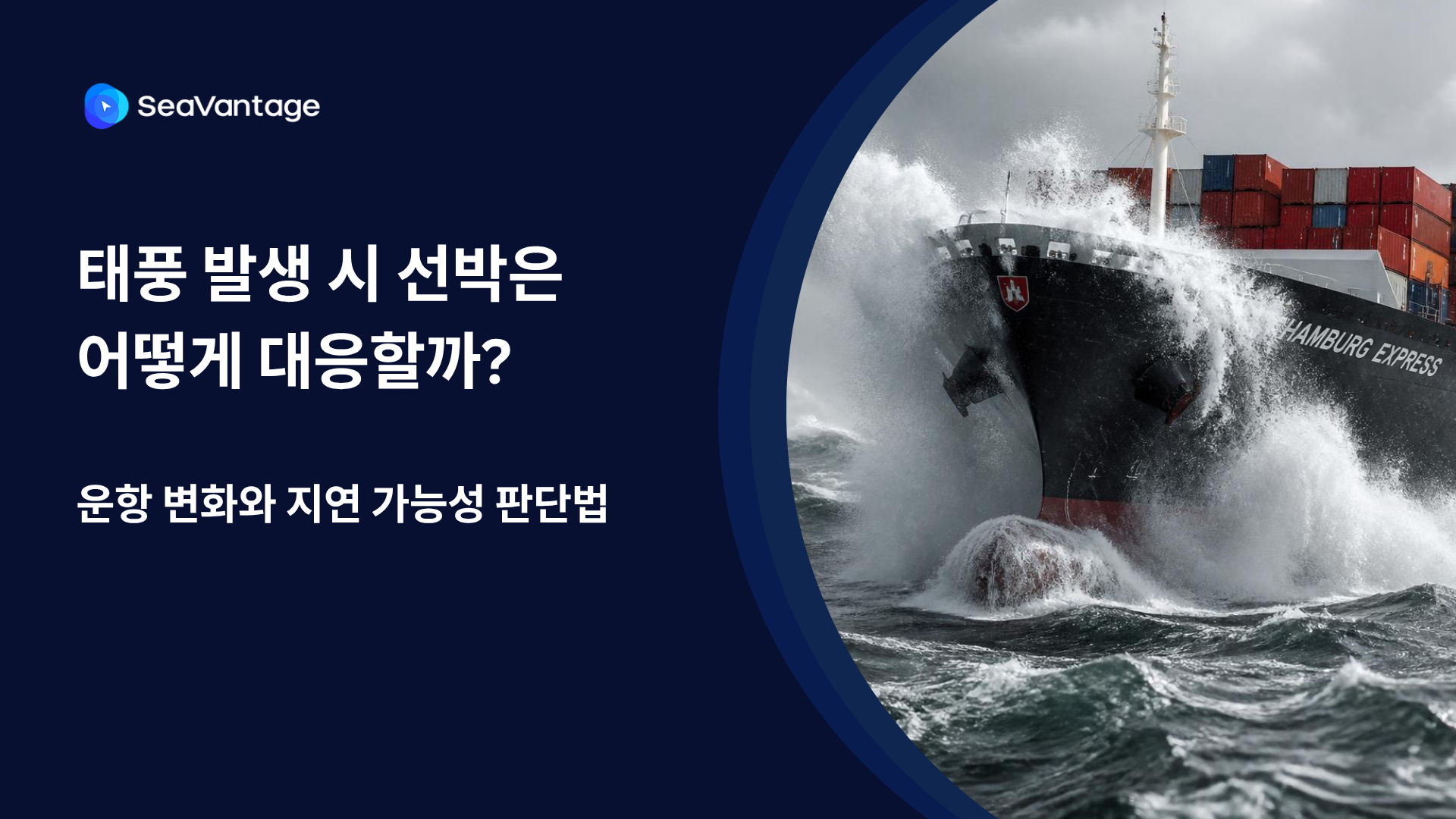
태풍 발생 시 선박은 우회·감속·대기 등 서로 다르게 대응합니다. AIS 항적과 ETA·PTA·PTB, 항만 혼잡 데이터를 활용해 해상운송 지연 가능성을 판단하는 방법을 알아보세요.
선사 ETA가 바뀌기 전에 일정 변동 가능성을 미리 파악할 수 있을까요? PTA와 ETA의 차이, 구간별 확인 방법, 실무 대응 시나리오 5가지를 소개합니다.
Need a SeaRates alternative? See how SeaVantage Cargo Insight supports container tracking, predicted arrivals, shipment milestones, and API access.
TPEB rates 2026, Indian Subcontinent ocean freight capacity, Strait of Hormuz shipping disruption, schedule reliability ocean carriers
What's driving ocean freight peak season 2026 — rates, surcharges, booking windows, and how to avoid missed inventory deadlines.

.png)


